
Namibia Highlights Sustainable Land Management & Degradation Neutrality Gains in Panama City
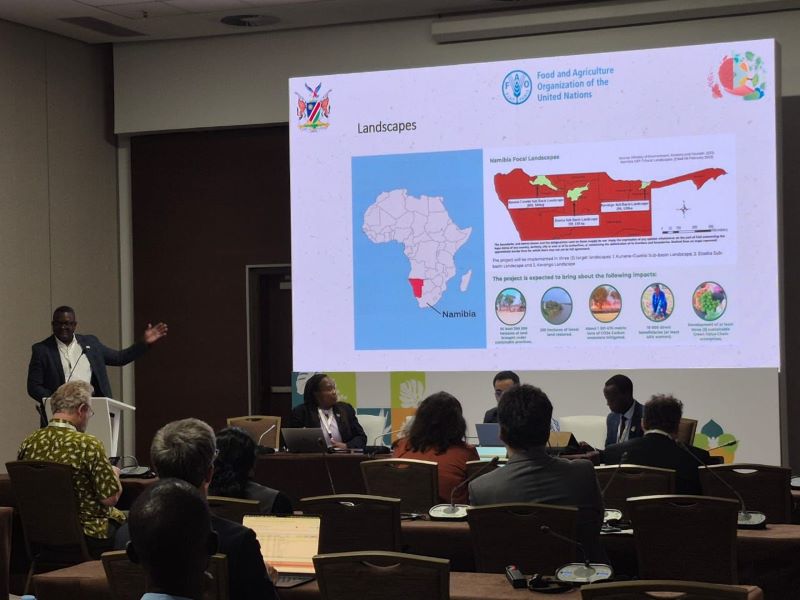
Namibia’s commitment to achieving Land Degradation Neutrality (LDN) and strengthening resilience across its dryland ecosystems was prominently showcased at the UNCCD CRIC23 in Panama City. During a high-level side event titled “Scaling Integrated Approaches for Drylands and Rangeland Resilience,” Kosmas Shilongo, National Project Coordinator for the Dryland Sustainable Landscapes Impact Programme (DSL-IP) Namibia Child Project, presented compelling evidence of the country’s integrated and community-driven achievements across the Kunene–Cuvelai, Etosha, and Okavango subbasin landscapes.
He highlighted the establishment of strong governance structures including triannual Landscape Management Committees (LMCs), a standardized fire cutline protocol aligned with FAO guidelines, and an LDN-focused Integrated Land Use Planning process measures that collectively enhance adaptive management, strengthen stakeholder coordination, and improve sustainable land-use decision-making.These initiatives demonstrate Namibia’s deliberate investment in systems that support long-term sustainability and climate resilience.
On-the-ground implementation efforts were presented as further evidence of progress. The project procured 27,500 kg of drought-resistant seeds, trained 70 farmers and 52 fodder producers, in the process of establishing community seed banks and indigenous plant nurseries, and rolled out extensive Training-of-Trainers programmes across Green Value Chains (GVC), Farmer Field Schools (FFS), and seed bank management. These actions, anchored in practical, scalable interventions, directly enhance food security, restore degraded landscapes, and transfer critical technical skills to community institutions. By expanding local capacity and strengthening climate-smart agriculture, the project is helping communities actively drive restoration while benefiting economically.
Shilongo also underscored significant progress in advancing Gender Equality and Social Inclusion (GESI). The project completed a gender mainstreaming assessment, validated a Gender Action Plan, and delivered targeted training to 27 representatives from producer organizations, support institutions, and the Project Management Unit. This work ensures that women, youth, and marginalized groups meaningfully participate in decisions and benefit equitably from land management interventions.
Embedding GESI into landscape governance broadens community ownership and strengthens the sustainability of project outcomes. Further demonstrating innovation, he showcased how the strengthening of green value chains—such as Mutete production, the Devil’s Claw value chain, the establishment of a thatching grass depot, and sustainable beekeeping training for 75 beekeepers— creates economic incentives that reinforce Sustainable Land Management (SLM) and Sustainable Forest Management (SFM) practices.
These value chains diversify livelihoods while reducing pressure on natural resources. They exemplify how the project links ecological restoration with tangible income benefits, giving communities practical reasons to adopt sustainable practices. A particularly impactful innovation presented was the piloting of FSC-certified charcoal production in the Etosha sub-basin. As Namibia faces bush encroachment across 45 million hectares, this intervention will provide a scalable solution for ecosystem restoration. The FSC Charcoal production initiative will be implemented in partnership with Mangetti Farmers Association promotes responsible harvesting, restores grazing potential, produces biochar for soil rehabilitation, and contributes biomass to the upcoming Oshikoto Biomass Power Generation Plant. By transforming an environmental challenge into a livelihood opportunity, the project demonstrates a model that delivers ecological, economic, and climate benefits simultaneously.
Shilongo further emphasized the project’s strengthened knowledge management systems. This includes the recruitment of five technical specialists, publication of multiple articles on FAO platforms, production of multilingual fire management awareness materials, support for community-to-community learning exchanges, and active participation in regional DSL-IP workshops. These efforts enhance visibility, facilitate cross-country learning, and ensure that communities and institutions are continuously equipped with relevant information and technical skills. Knowledge exchange is essential for scaling best practices and building resilient landscapes across Namibia and the wider region.
Shilongo concluded by noting that the project has successfully undergone a Mid-Term Review and continues to meet reporting and compliance requirements. Supported by the Global Environment Facility (GEF), technically-supported by Food and Agriculture Organization (FAO) and implemenmted through MEFT and MAFWLR, the DSL-IP Namibia Child Project reflects a well-coordinated national effort. Its holistic and collaborative approach demonstrates Namibia’s growing capacity to combat desertification, land degradation, and drought. Ultimately, this work positions the country’s commitment in sustainable dryland management while making substantial contributions to national and global LDN and SDG 15.3 targets.