

Kenya Confirms Single Imported Ebola Case After Patient Dies in Nairobi
President William Ruto has convened the National Security Council and placed 35 people under quarantine after an imported Ebola case proved fatal — though officials insist surveillance of more than 650,000 travellers has so far returned no further positives.
Nairobi — Kenya’s government has confirmed the death of a single patient from an imported case of Ebola Virus Disease, announcing an “enhanced response” that stretches from border screening posts in Busia and Bungoma to quarantine wards in Nairobi.
In a statement issued by State House Spokesperson Hussein Mohamed, MBS, President Ruto said he had ordered the National Security Council Committee (NSCC) to convene, assess the situation and recommend measures to safeguard the country following the fatality. The Council met, and the government says it has since intensified surveillance, contact tracing and treatment capacity.
A Single Positive Among 267 Samples
The most reassuring line in the release is also its most quoted: of 267 samples tested across five laboratories since the outbreak began in May 2026, only one returned a positive result — that of the deceased patient. “No additional positive cases have been detected,” the statement reads.
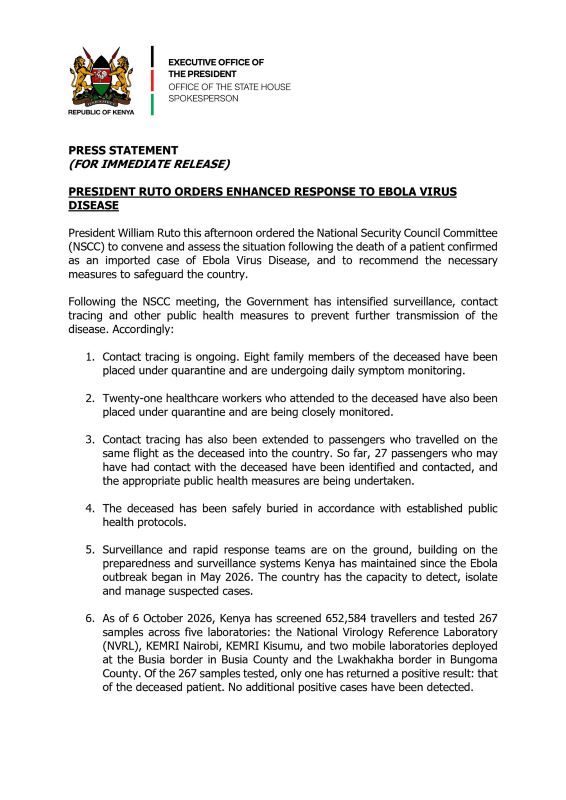
That single sample sits inside a much larger screening operation. As of October 6, authorities say Kenya has screened 652,584 travellers, using the National Virology Reference Laboratory (NVRL), KEMRI Nairobi, KEMRI Kisumu and two mobile laboratories deployed at the Busia border in Busia County and the Lwakhaaka border in Bungoma County.
35 People Under Quarantine
Contact tracing has moved outward in concentric circles from the deceased. Eight family members are under quarantine with daily symptom monitoring, along with 21 healthcare workers who attended to the patient. Twenty-seven passengers on the same flight as the deceased have also been identified, contacted and placed under appropriate protocols.
The patient, the statement confirms, “has been safely buried in accordance with established public health protocols” — a detail that carries weight in a disease where unsafe burial practices have historically driven transmission.
Capacity on Standby
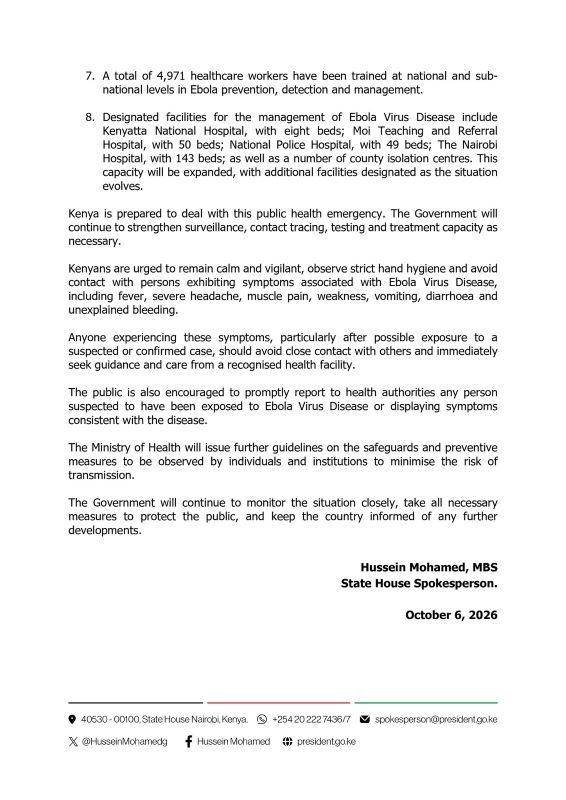
Designated treatment facilities include Kenyatta National Hospital (eight beds), Moi Teaching and Referral Hospital (50 beds) and the National Police Hospital (49 beds), alongside county isolation centres. The largest single reserve is Nairobi Hospital with 143 beds. All told, 4,971 healthcare workers have been trained nationally and sub-nationally in prevention, detection and management, with further facilities to be designated “as the situation evolves.”
The Message to Kenyans
The government urged calm while asking for vigilance: strict hand hygiene, avoidance of close contact with anyone showing fever, severe headache, muscle pain, weakness, vomiting, diarrhoea or unexplained bleeding — particularly after possible exposure. Anyone with such symptoms should seek care immediately rather than manage it at home, and the public is asked to report suspected exposures to health authorities.
“The Government will continue to monitor the situation closely, take all necessary measures to protect the public, and keep the country informed of any further developments,” the spokesperson wrote, adding that the Ministry of Health will issue further guidelines on safeguards for individuals and institutions.
For now, the official position is one of containment rather than crisis: one imported case, one death, and a screening apparatus that has yet to find a second infection.
Source: Press Statement, Office of the State House Spokesperson, Republic of Kenya, October 6, 2026.