Incwala: Inside Eswatini’s Sacred Festival of First Fruits
A ceremony of water, fire and secrecy that binds a kingdom to its king — and refuses to perform for visitors. For three weeks each summer, Eswatini turns inward. What happens inside the royal byre is not for sale, not for the camera, and not for you.
When we think of cultural festivals, we picture vibrant dance, colourful dress and communal feasting. Behind many traditions lies a deeper layer: sacred ritual, mysticism and rites performed out of public view. These hidden elements are not sinister. They are revered, reserved for initiates, and central to what a celebration means.
One such festival is Incwala, the most important cultural event in Eswatini. Often called the “festival of first fruits,” it is far more than a harvest ritual. It is a kingship ceremony — an act of purification, renewal and the spiritual reinforcement of the monarch. Without a king, there is no Incwala.
Timing the Festival
Incwala falls between December and mid-January, its exact dates set by the moon and announced only shortly beforehand. The 2025/26 ceremony began on 20 December 2025, with the main day of the Big Incwala held on 6 January 2026. The festival unfolds in two stages: the Little Incwala (Incwala lencane) and the Big Incwala (Incwala lenkhulu).
The Little Incwala
The journey begins around the full moon in December. A group known as the Bemanti (“water people”) sets out from the home of the Ndlovukati, the Queen Mother. One party travels south towards Catembe, near Maputo, to collect seawater; another heads north for river water. They return to the royal residence with the new moon, opening the Little Incwala — days of dance, song and ritual led by the Queen Mother alongside the regiments.
The Big Incwala
Roughly two weeks later the main ceremony begins, building through a sequence of rites to its climax.
- Cutting the lusekwane. Under the full moon, regiments including Ingatja and Libutfo march many kilometres to cut branches of the sacred lusekwane shrub, after formal commissioning by the king. The branches are carried to the national cattle byre, where elders weave them into the king’s private sanctuary, the inhlambelo.
- The imbondvo and the bull. Youths gather branches of imbondvo (red bush willow) for the same sanctuary. Later a bull “escapes” from the byre — a test of courage, as the young men must subdue it with their bare hands.
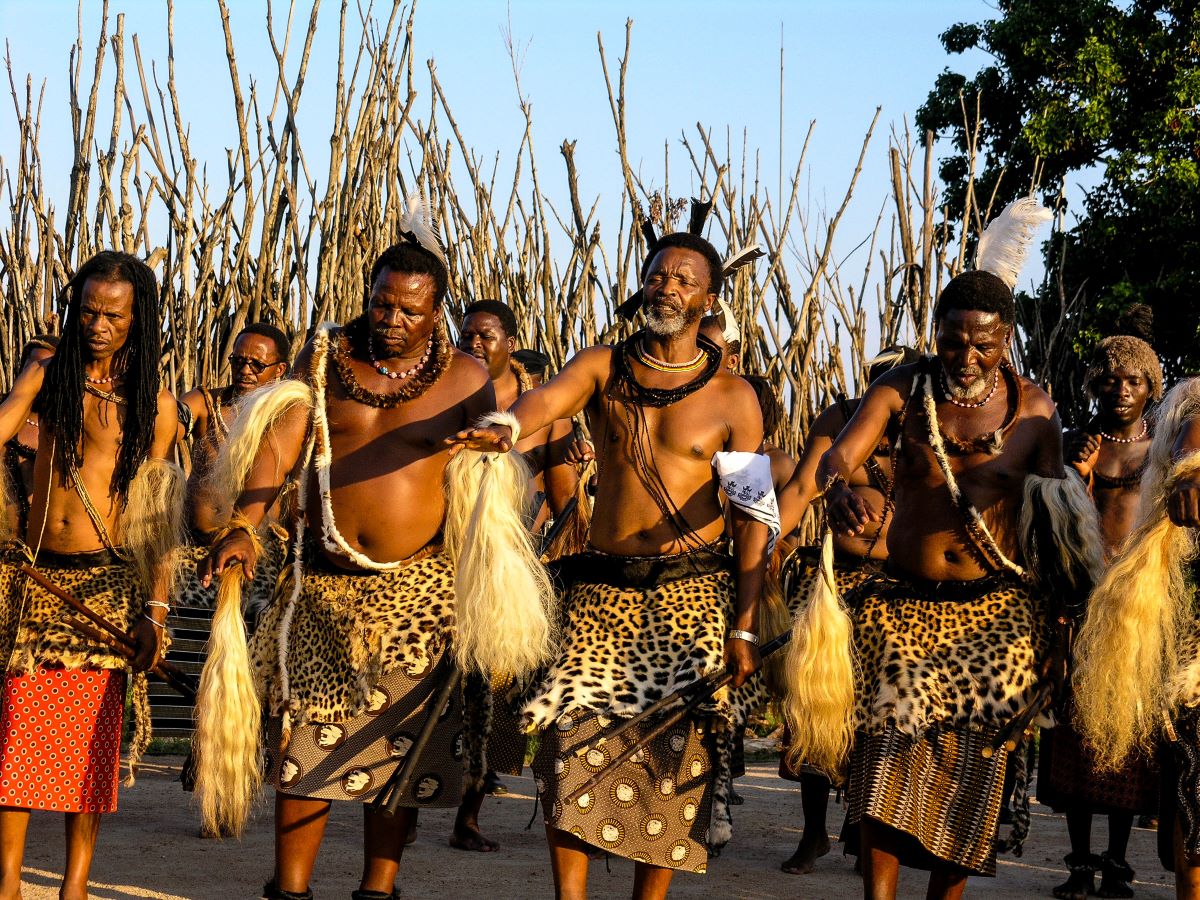
- The main day. Dressed in war regalia, the nation dances and feasts while thousands fill the royal parade grounds. The king eats the first fruit of the season, symbolically opening the harvest to all. At the height of the dancing he emerges from the inhlambelo and casts a sacred gourd, caught on a shield by one of the lusekwane boys.
- A day of abstinence. The Bemanti enforce strict rules: no sexual contact, bathing, singing, dancing or adornment. The king stays in seclusion, seen only by his ritual wives.
- The Day of the Log. Elders raise a great bonfire in the cattle byre. Ritual objects burn, closing the old year. Song and dance continue until rain puts out the fire, followed by feasting.
The king remains in seclusion until the next full moon, when the lusekwane branches are burned and the ceremony ends.
Visiting Incwala: respecting tradition
Visitors are welcome, but Incwala is not staged for tourism, and much of its inner workings remain deliberately hidden from outsiders. Respect for local custom is not optional — it is the price of being there.
- Dress. Men should go bareheaded unless wearing traditional headgear. Women should wear skirts or sarongs rather than trousers or shorts.
- Footwear. No shoes in the dance arena.
- Photography. Permits are required, and images of the inhlambelo or its rituals are strictly forbidden.
- Timing. Dates shift with the lunar calendar and are confirmed late, so build slack into any trip between December and mid-January. The 2026/27 dates were still to be confirmed as of the last official announcement.
- Conduct. This is a ceremony, not a show. Observe quietly, follow local guidance, and let go of the expectation of access.
Incwala is more than a festival. It is a living expression of Eswatini’s cultural identity, spirituality and monarchy — and, as the strong turnout at the 2025/26 ceremony showed, an institution that continues to command broad national support. For travellers it offers a rare glimpse of a tradition that has resisted conversion into spectacle. It is a reminder that travel is not only about seeing new places, but about learning from the communities that keep ancient practice alive.