

MKTE 2025: Kenya Airways on Partnership, Connectivity, SAF, Competition and More…
Kenya Airways (KQ), the official airline partner of the Magical Kenya Travel Expo (MKTE 2025), held a media briefing at the Media Centre of Uhuru Gardens National Monument and Museum, Nairobi on Thursday 2 October 2025. At the briefing, Rose Kiseli, the airline’s General Manager (Commercial) for East, Central and North Africa, addressed the hosted media delegates on KQ’s role as a strategic enabler of tourism, trade and connectivity across the African continent and beyond.
The delegates who were drawn from various parts of the world, also had a chance to ask the KQ official questions in a convivial interactive session that lasted about hour. Responding to a question, Kiseli explains how Kenya Airways has some partnerships, for instance which entails customers being able to book one ticket, a single ticket that allows them to travel from JFK International Airport in New York into Nairobi.

On arrival in Nairobi, they will get a transfer to Wilson Airport (domestic) and catch Safarilink flights to any of the numerous national parks and back the same way. Safarilink is Kenya’s premier safari airline with a network of connecting domestic scheduled services to all the best safari destination within Kenya and across the border into northern Tanzania and Zanzibar.
According to Kiseli, the advantage of this arrangement is that the tourist is able to check in their bags easily with Safarilink already expecting them. This gives more visibility to the tour operators, and it is more price competitive. Also, the process between the two airlines is easy seamless, especially when groups of passengers are traveling on different airline. If one airline has an issue and the other has no information, they won’t be able to make any adjustments to accommodate the customers.
The partnership is for the customers benefit in terms of seamless connectivity and also visibility for the tour operators – so they are able to connect when there are large groups. With Safarilink able to operate from Jomo Kenyatta International Airport and pick the group, the issues of land transfer is eliminated.
The GM Commercial explained that the codeshare is live and the systems have been interlinked from early this year. She pointed out that the partnership had been in place for some time, however it suffered a bit of disruption during COVID. Post-COVID, the partnership has been there for two years, but the systems were integrated this year.
Answering the question about a free stopover to Nairobi, Kiseli referred to it as an interesting proposal, stating that it is a work in progress with support expected from other stakeholders. At the moment, the government has already given through the visa waivers. However, there is a need to collaborate with Kenya Wildlife Services (KWS) for access, and Kenya Tourism Board (KTB) on concessions, as well as other tourist stakeholders. For now though, she emphasized there is no yet the free stopover, but it is definitely in the works.
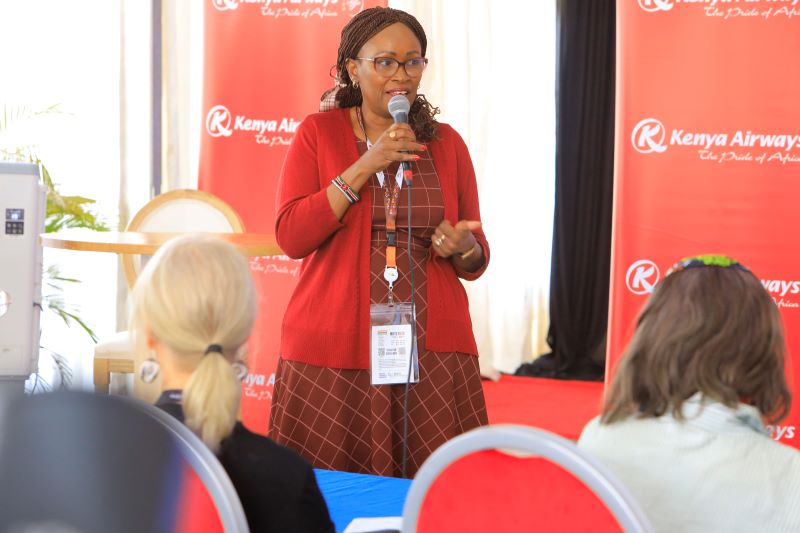
When responding to a question regarding growth in traffic from the US, Rose Kiseli said, “We have continued to maintain our frequencies. So, we have not had any need to change our schedule from the US. In fact, during summer we grew capacity compared to last year. So the answer is there’s still a lot of traffic from the US into Kenya and beyond – and the advantage of this flight is that it offers, first of all, a one-stop into Africa and then you’re also able to not just visit Kenya, but you can combine Kenya with other places around.”
Speaking further, she explained that there are tourists who come to Kenya, proceed to Victoria Falls in Zimbabwe, or perhaps Livingstone in Zambia, and then continue the journey to Cape Town, South Africa; and they come back by the same route. This links a lot of the destinations.
“Like Seychelles, Mauritius, what we call the Vanilla Islands or the islands around the Indian Ocean, and Zanzibar, and Kilimanjaro. But the safari in Kenya is the main attraction. So we say you stop and do your safari and then also have a chance to visit other points – even West Africa. From here you can go to Nigeria, Ghana and do a circular with our partner Delta. So the opportunities are endless.”
Furthermore, Kiseli mentioned that Kenya Airways is also positioned to support the decision by the UN to move some of the offices to Nairobi. With some of the UN offices in New York relocating to Nairobi, there is going be more traffic into Kenya’s capital, which will also bring in an expatriate community that is both willing and able to tour Africa. They visit other parts of Africa from Nairobi during weekends and during their breaks, instead of flying back home.
In effect, Kenya has positioned itself not just as a hub for tourism, but also for business. According to Kiseli, the Kenyan government is making efforts to position Kenya as a big MICE destination. In sub-Saharan region, Kenya ranks third after South Africa and Rwanda. She believes Kenya has a big opportunity with the infrastructure available in the country, access by air, and also the visa regime to move up the ladder. These, in addition to good weather and warm friendly hospitality are good reasons to bring your meetings to Nairobi.
Speaking about sustainability, Kiseli proudly stated, “First of all you know, Kenya is leading the way in Africa in the conversation around sustainable aviation fuel (SAF). We have operated a couple of flights under the Sky Team Challenge over the years to Amsterdam mostly and Paris. A full staff flight from Africa; the first ever – and the subsequent year, the second ever.
“This year we intend to operate nine flights on SAF – again the same challenge. We will incorporate an Inter-Africa flight which will be from Cape Town. We’ll add Cape Town and we’ll do a number of flights to Europe. And this is just to contribute to the conversation in the aviation industry around sustainable aviation fuel.”
Making clarification on the term challenge, she said, “We all know that SAF is extremely expensive. So the development or the innovation space is looking at how we can move in a direction where we are able to operate less fossil fuel and more into the sustainable fuel.”
She pointed out that the airlines that are doing this are actually testing the space. It is at a development stage. So KQ, does not operate fully staffed planes, but it is done only for the challenge. When it is done, “we make sure that every product, everything we use on that flight is recycled, reuse, and all that, around sustainability.” She promised KQ will provide more information on this subsequently.
When the issue of competition among Africa’s leading airlines was brought up, Kiseli stated, “First of all, our first aim is to complement and work together in Africa to promote visits in and out of Africa. The next thing is that Kenya Airways is looking at an expansion plan. So with the right level of investment, we look to grow so that we can be able to operate to more points and support what is happening, next door with Ethiopian Airlines.”
She explained that travel into Africa is growing faster than travel out of Africa, and also travel within Africa is equally growing faster than, other parts of the world. For instance, Kiseli noted that, this year has witnessed about an 8% growth, while other markets have 2%, with some even showing a bit of decline. This is an indication that Africa is the next frontier, and growth is inevitable.
“We have positioned ourselves to be able to tap into this growth, in order to be able to complement. And this is not just Kenya Airways and Ethiopian Airlines. It’s also includes other African airlines, because those of us from Africa know how difficult sometimes it is to move from here to another African city, where you need maybe to touch Europe and come back into Africa to go to Nairobi, to Morocco, or you need to touch Middle East to come back to an African city. So maybe you’re going to Eritrea. It’s not too far, but you may need to go to Dubai and then come back in.”
In closing, Kiseli agreed that there are a lot of opportunities. This necessitates the growth of more African carriers. However, Kenya Airways is positioned for that – to grow so that it can operate more destinations, across the globe that are of significance to the nation’s economy.