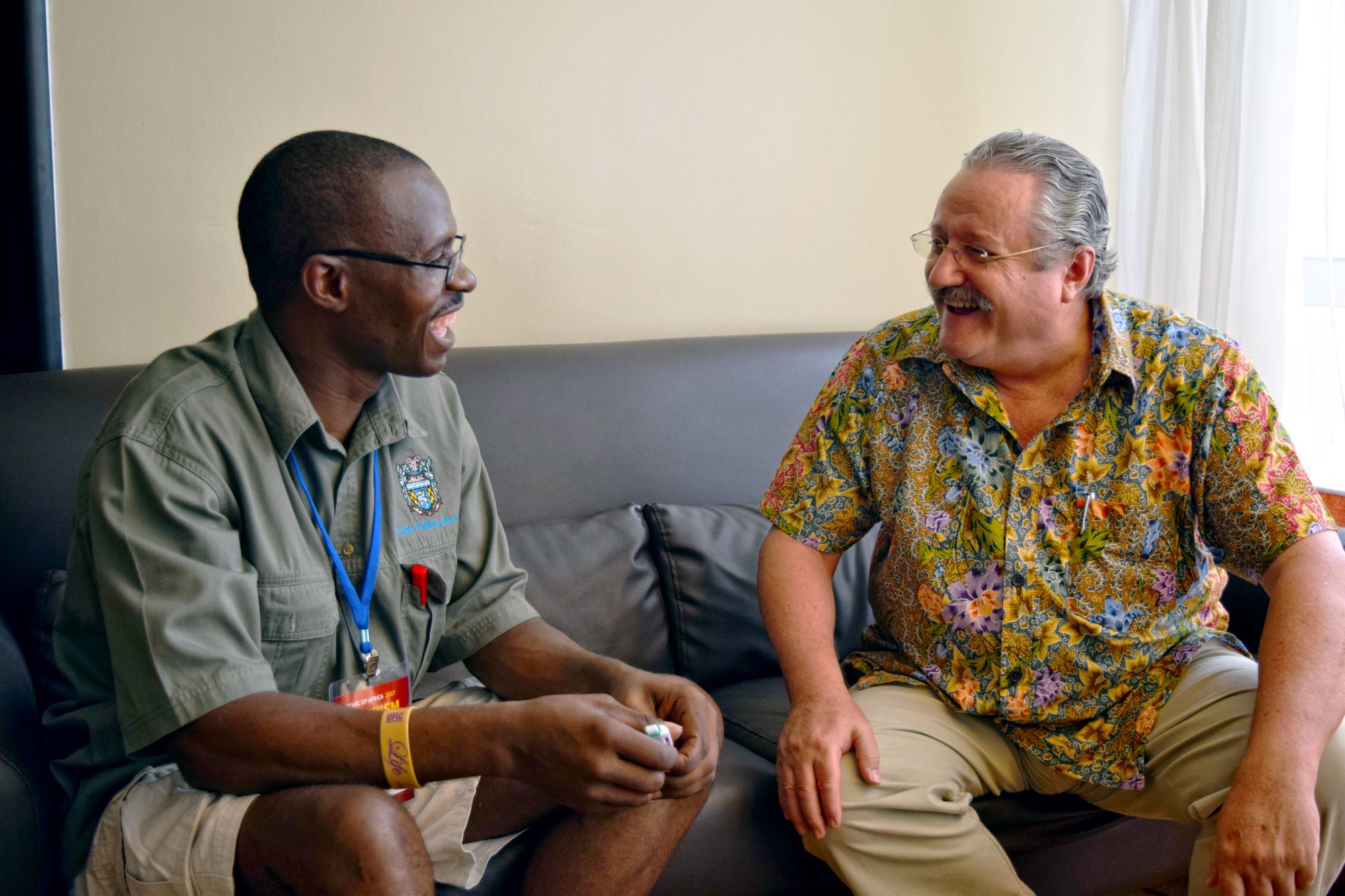
“Talking Tourism with Prof. Wolfgang Thome” An Interview by Cephas Shonhiwa
CEPHAS: Prof., you have been in Zimbabwe so many times. You know our place, you know our products. You know what Zimbabwe has to offer. Now we have been here on a fam trip. I have seen what Uganda has to offer. What can you say about these two destinations, in terms of selling their products?
PROF: Well, the two countries have attractions which complement each other. Each country has specific highlights: Zimbabwe, it’s the Victoria Falls; Uganda, it’s the gorillas. The good thing for twin-centre holidays, covering both countries is that today a number of airlines fly both to Entebbe and to Harare and soon also to the Victoria Falls.
So it will be possible to combine using the right airline – that is a prerequisite of course. It will be possible to combine country visits, coming from Europe, coming from the Gulf, coming from beyond to fly to Entebbe and then fly on to Harare and fly home from there. The idea always is for me, it has always been that when people come a long distance, for instance from the United States of America which is a very big source market for you, which is a very big source market for Uganda and for the East Africa; when they come all this way and they have spent so much money on airfare, it makes sense to say, “I’m not just going to one country. I’m going to two or three countries, if possible.”
Here in East Africa, we facilitate that through our Uni-visa: Kenya, Uganda, Rwanda; you do it with Zambia and even for day trips across the border into the Botswana national parks. So the attractions you have, the attractions we have adds highlights to a trip. The people come to Uganda as a first stop, or as a second stop, see the attractions here, go tracking for the gorillas, see the chimpanzees, see the source of the Nile, see the Rwenzori mountains also known as mountains of the moon; and then they move on to see the vibrant city of Harare, see the world’s greatest waterfalls, Victoria Falls (which you share with your neighbors, Zambia).
They can go too see Great Zimbabwe, which is manifest of a civilization which was all superior to European civilizations at a time. (It) puts paid to suggestions that Africa never had social structures. Just like Egypt, thousands of years ago from where civilization really sprung; it inspired the Greeks and all the others. Great Zimbabwe is also a historical and cultural piece of evidence that they were great civilizations in those days already.
There are many similar smaller monuments across the country and of course there are the national parks. Hwange, for instance which I believe is the park with the highest population of elephants in Africa. And many other parks too; it would go too far to name each and every one of them, but some of them, Matopos for instance is stunningly beautiful in my view with the rock formations and everything – with the rock paintings for instance, again a sign that civilization was that mankind lived these parts of Africa. In other continents, there is hardly any evidence that people were around in those days.
So this is all the reason why one should visit more than one country to see great attractions and I think Uganda and Zimbabwe have very cordial relations, so it would make sense to visit both in one go.
***
CEPHAS: Thank you very much Professor. As far as media is concerned, what can you say about the publicity of these two nations?
PROF: Africa per se is not richly with the positive media attitude from a particular section of the international media. Aided by travel advisories, or made worse by travel advisories from certain countries against African destinations, (you are as much affected as we are), very often leaves the impression in the eyes of readers and viewers that Africa is unsafe, unstable and has all sorts of shortcomings.
When you live here; I’ve lived in East Africa now for close to 42 years. For me, it is home. I know better and I tell people I know better – and of course I write. I’m a travel writer and I have the opportunity to tell some of my more than 1.4 million readers I have for my blog, that the way they hear and read about Africa, and learn about Africa is not necessarily the truth on the ground. And I think we as African countries have a great challenge to overcome the perception.
Our tourism boards needs to do more. Our ministries of tourism need to do more to positively influence, in particular the travel media to report better about us and not be caught up in hype and anti-African media which so often dominate headlines.
I’ve been greeted in remote parts of Zimbabwe. I get out of the bus, look for a soda, and people come up to me, shake my hand; say “Welcome back to our country.” This is reality. What people read in western media very often is that visitors, in particular Caucasians, white people, are hated in Zimbabwe. It’s not the case at all. Streets are still named after all this time, since independence? Cecil Rhodes’ grave is left undisturbed in Matopos National Park at Worldview, on top of the hill and the Zimbabwean government has regularly said, “This is part of our history. We are going to keep that.”
These are things the international media should look at and help to showcase the attractions of our countries to their readers. Not scared their readers away, when they are supposed to be travel media. You are not supposed to scare people away. You are supposed to create images in people’s mind that they have this sudden urge to travel; not to write reports which stops them dead in their tracks.
***
CEPHAS: So do you think these familiar relationships makes a difference in probably mitigating the effects of bad publicity outside.
PROF: Well, to some part, have hosted buyers – and those are the key individuals really to start with – the opportunity to sample the products and the attractions and they become your shops. They become your shops where Zimbabwe is sold in their travel agencies back home, in their tour operating businesses back home. They are now suddenly Zimbabwe shop outlets to sell vacations. So yes, it’s very important that people get acquainted with the product and can sample it firsthand; and not have to rely on the negative media.
***
CEPHAS: What do you have to say about Southern Africa?
PROF: It’s a great part of our continent with many great attractions as a region. You are cooperating very well and I can only applaud it through RETOSA. You are cooperating under the umbrella of SADC. So it is possible to visit countries in the region, because you have safari operators operating cross border in to Zambia, in to Botswana, in to Namibia, even in to Mozambique, in to South Africa. It’s one of the great regions of our continent. Though I prefer to be in East Africa, to be quite honest.
And about Zimbabwe in particular, it is one of the most underrated destinations in Africa. I know it. If we go around, and even go to the Pearl of Africa tradeshow now and ask people who have been in the travel business for a long time, what they know about Great Zimbabwe, what they know about the Victoria Falls, what they know about all these wonderful national parks: Mana Pools for instance, I have mentioned Hwange before.
They would probably be at a loss to explain. They know there is Zimbabwe. They know probably a little bit about the history. They know you have a long-serving president – and I’m not going into that field, because this is entirely internal affairs of the Republic of Zimbabwe, and it’s for you to decide. You know what’s going on politically in your country.
I look at the country as a tourist destination, and as such, I can only recommend that people put it on their bucket list. They should visit countries from A to Z, and Zimbabwe is a “Z” in the alpha and the omega. So Zimbabwe should be seen as the omega of travel destinations around the world, travel destinations in Africa.
The more often I go back, the more I like it. It starts from Harare when I enter the country, go to immigration, friendly faces; you know, no questions asked, I pay much smaller fees than tourists with pay in East Africa. Traffic is not as bad in Harare as it is everywhere in Nairobi, in Kampala, as we know – Dar es Salaam too.
People are friendly. This is something which overwhelmed me literally when I first came there – how friendly people were. I expected frowns looks, you know, skepticism, nothing of the sort. You go into a shop, buy a SIM card, you do a registration; people are friendly talking, chatting away, asking where you come from, where you go, what you visit. And you say I come from that part, and they’re happy.
CEPHAS: Yes, I’ve also experienced, happy people here in Uganda.
PROF: We are happy people.
CEPHAS: Yes, and the other good thing that I’ve also realized in the start, you keep your town, you keep your national parks clean.
PROF: We try. We have challenges. Plastic bottles; is one of them. I know we need clean drinking water, but plastic bottles need to be recycled, not trust away. Look, we have challenges, but we are aware of them, we are dealing with them. You’ve changed too with elephant numbers. People very often overlook it, you know, this is a country with the most elephants in Africa, isn’t it? Hwange is a park with the most elephants in any national park in Africa. So, of course, you have carrying capacity issues and things like that.
One has to understand the complexities of tourism and conservation going on in our country. It’s not an easy field. There are no solutions off the shelves; that you come from abroad as a consultant, and you impose your pre-conceived recommendations – this is not possible. We need to find solutions within, and make these solutions work because we owe it to future generations. Your country is working on that, my country is working on that, and of course, we have challenges, but this is what life is all about. You meet the challenges and you struggle to overcome them.
CEPHAS: Professor, thank you very much for your time.
PROF: It was my pleasure. Next time I come, I must make sure Lake Kariba is on my visiting programme, so I can see your own backyard.
This article featuring an interview conducted by the MD of Malachite Travel and Tours and it appears in the maiden edition of Travels & Thrills magazine, published by More Cream Than Coffee in January 2025.