Gorongosa Bags E.O. Wilson Legacy Award for Transformative Conservation Leadership
At Harvard’s Half-Earth Day 2026, the Mozambican park’s restoration of wildlife, science, and community resilience was celebrated by Harrison Ford, Harvard leaders, and Mozambique’s ambassador.
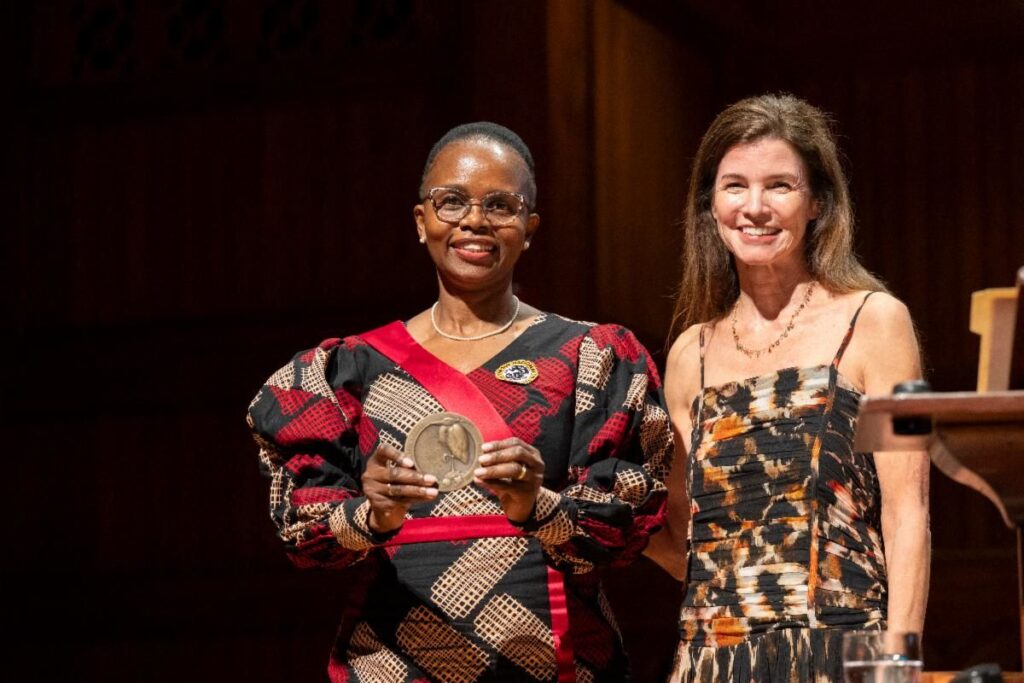
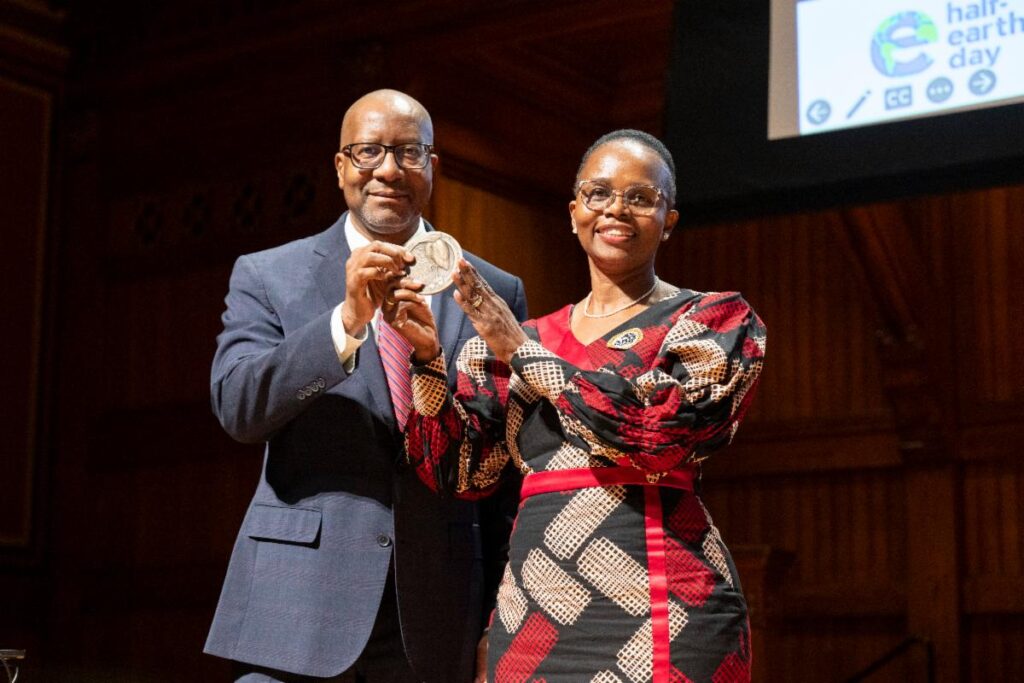
Cambridge, Mass. — The Gorongosa Restoration Project was honored with the E.O. Wilson Legacy Award for Transformative Conservation Leadership at Half-Earth Day 2026, held on 12 October at Sanders Theatre, Harvard University.
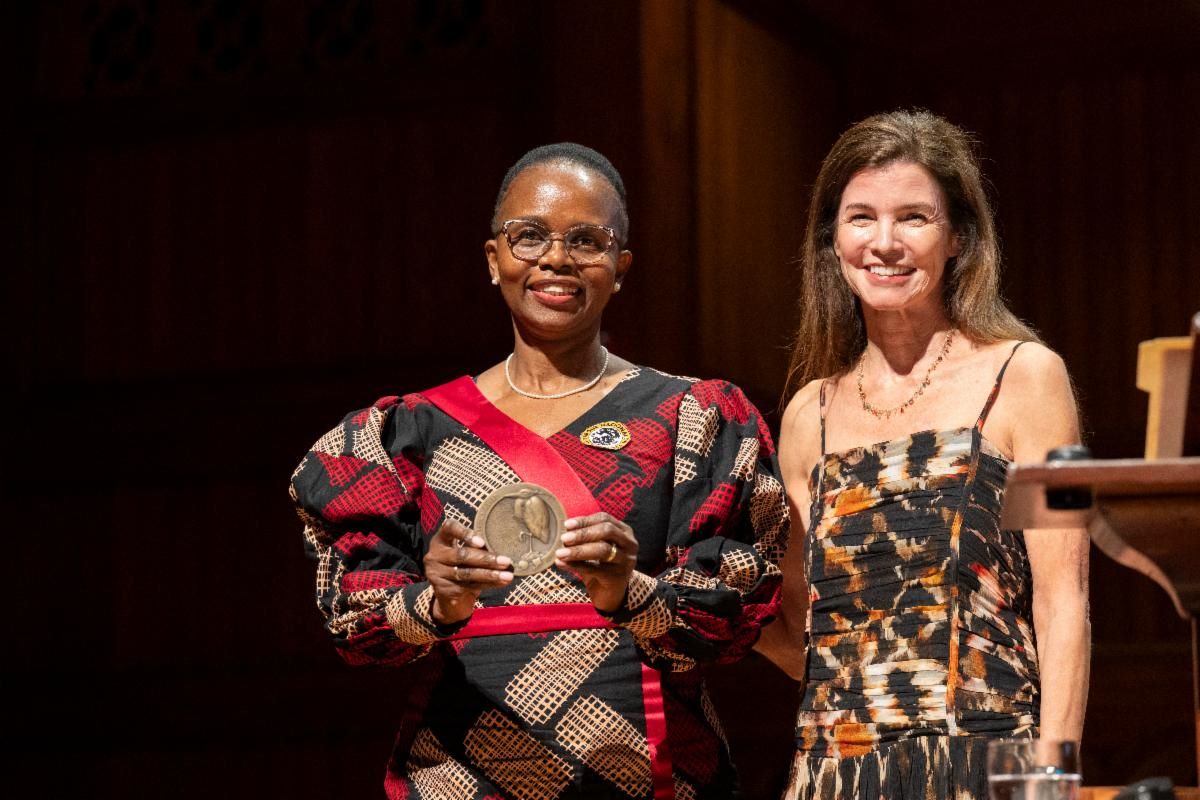
Dr. Paula J. Ehrlich, President and CEO of the E.O. Wilson Biodiversity Foundation, presented the award to Aurora Malene, CEO of the Gorongosa Restoration Project, who accepted it on behalf of the scientists, rangers, and community teams driving the park’s recovery.
The presentation opened with a short film narrated by Greg Carr, founder of the Carr Foundation, detailing E.O. Wilson’s deep connection to the park and the young Mozambican scientists now continuing his work there. Harrison Ford, who received the inaugural E.O. Wilson Legacy Award at Chicago’s Field Museum in October 2025, passed the honor forward via video message.
“Ed Wilson loved Gorongosa. He said it looked like it did before the coming of humanity,” Ford said. “The Gorongosa Restoration Project—rangers, scientists, teachers, doctors, and the young Mozambicans who are now leading this work—have spent more than 20 years making sure it stays that way. That’s what this award is for. And I can’t think of anyone more deserving of it. It is my honor to pass the E.O. Wilson Legacy Award to the Gorongosa Restoration Project.”
A Living Symbol of Resilience
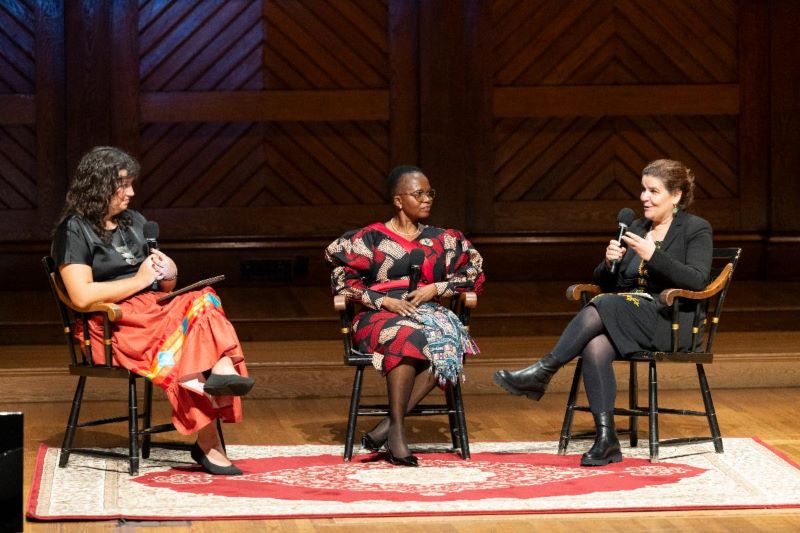
In her keynote address, Malene reflected on the broader impact of the park’s restoration. “Perhaps the greatest measure of restoration is not only what we bring back,” she said, “it is what we make possible.”
Her remarks were followed by a conversation with Dr. Susana Carvalho, Gorongosa’s Director of Science, hosted by emcee Adrienne Keene.
The event was attended by His Excellency Alfredo Nuvunga, Ambassador of Mozambique to the United States, who spoke to the park’s significance beyond ecology. “For Mozambique, Gorongosa is much more than a national park,” Nuvunga said. “It is a living symbol of peace, reconciliation, resilience, and hope. Gorongosa has become an inspiring example of how nature can recover, communities can rebuild, and hope can be restored. In many ways, Gorongosa tells the story of Mozambique itself—a nation that has faced adversity but continues to believe in the power of peace, renewal, and partnership.”
Two Decades of Restoration
The award recognizes organizations that carry forward Wilson’s work in conservation science, public engagement, and movement-building. Wilson’s bond with Gorongosa began in 2008, shortly after Carr signed an agreement with the Government of Mozambique to restore the park. Wilson visited three times, staying roughly a month each visit, and helped document more than 200 ant species—20 of them new to science. The park’s research center, the E.O. Wilson Biodiversity Laboratory at Chitengo, bears his name.
Between 1972 and 2000, Mozambique’s civil war decimated Gorongosa’s wildlife, wiping out more than 90% of its large animals. Restoration efforts, formalized in 2008 through a public-private partnership between the Mozambican government and the Carr Foundation, have since reversed the decline. The park now supports more than 100% of the wildlife biomass it held in the 1960s.
Key recovery milestones include:
- Mammals: Populations of elephants, waterbuck, impala, reedbuck, kudu, and nyala are flourishing. The lion population, which had fallen to single digits in 2004, now exceeds 250.
- Science & Discovery: Over 80 partner universities—including Harvard, Princeton, Stanford, Oxford, Cambridge, and Lyon—collaborate in the park. Researchers have documented more than 8,000 species in the Greater Gorongosa landscape, roughly 200 of them new to science.
- Education: Gorongosa offers the world’s only Master’s in Conservation Biology based entirely inside a national park, having graduated 48 Mozambican students who now serve in parks, universities, and government. Six staff members have secured competitive PhD scholarships at top institutions in the UK, Portugal, and South Africa.
- Recent Discoveries: In July 2026, a survey team at the E.O. Wilson Biodiversity Laboratory recorded approximately 592 plant, animal, and fungal taxa, 48 of which were undocumented in the park. One dung beetle (Drepanocerus species) appears to be entirely new to science.
“Our work today is led by Mozambican scientists and reflects the very essence of what Gorongosa stands for: science in service of people and nature,” said Dr. Carvalho. “We believe that science only matters if it builds people alongside knowledge.”
About the Award
The E.O. Wilson Legacy Award for Transformative Conservation Leadership was established by the E.O. Wilson Biodiversity Foundation in 2025. It honors exceptional leadership in scientific contribution, public engagement, and movement mobilization that drives measurable conservation outcomes.
Half-Earth Day 2026 marked the tenth anniversary of Wilson’s Half-Earth movement, his call to protect half the planet’s land and sea for the rest of life. The event was co-hosted by the Harvard Museum of Comparative Zoology, Harvard University Herbaria, the Harvard University Native American Program, the Salata Institute for Climate and Sustainability, and the E.O. Wilson Biodiversity Foundation.
Edward O. Wilson (1929–2021), a Harvard biologist and two-time Pulitzer Prize winner, is widely regarded as the father of biodiversity. As Carr noted, “Ed Wilson was a great man, but he was also a good man. And it’s not that often that those two traits come together in the same person.”