
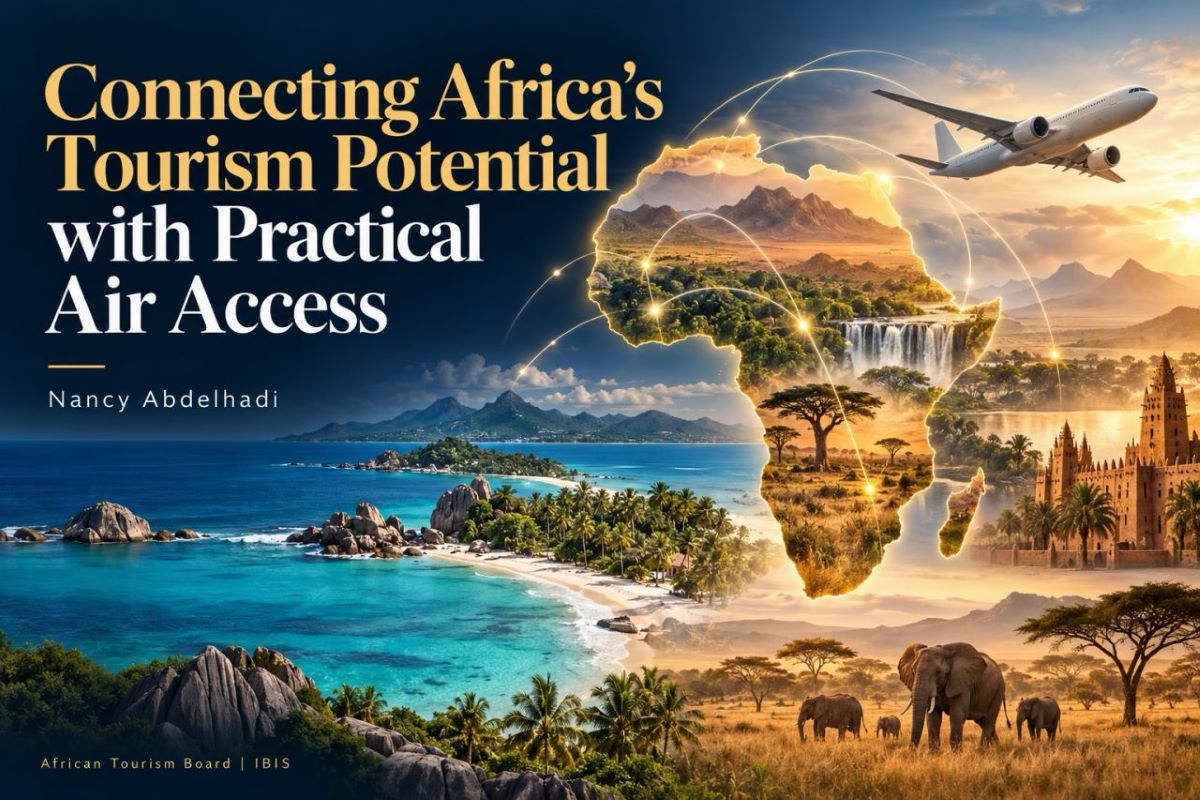
Open Skies, Open Doors: Why Africa’s Tourism Boom Needs Air Access More Than Advertising
Africa welcomed 81 million visitors in 2025 — the world’s fastest-growing tourism region. But as the African Tourism Board’s COO argues, the next leap won’t come from better campaigns. It will come from seats, fares, visas and conversations that start before the first brochure is printed.
In Tanzania, Zanzibar, Rwanda and Kenya, the conversations kept circling back to the same stubborn gap. Not whether Africa’s destinations are extraordinary — they are — but how a traveller inspired by them actually gets there without paying a fortune or stringing together three separate visas. As Nancy Abdelhadi, Chief Operating Officer of the African Tourism Board and Founder & Chairman of IBIS, puts it in her recent reflection: “How do we turn the appeal of our destinations into journeys that people can realistically book and afford?”
It is a deceptively simple question, and it lands squarely on an industry riding an impressive wave. Africa was the fastest-growing tourism region in the world in 2025, welcoming roughly 81.3 million international visitors, up 8 per cent from the year before. North Africa led the surge with an 11 per cent increase, while Sub-Saharan arrivals climbed 5.5 per cent to around 45.6 million. Demand, in other words, is not the constraint.
Marketing Is Only Half the Job
The temptation, when numbers look this good, is to keep doing more of what worked: more campaigns, more trade shows, more glossy destination films. Abdelhadi’s argument resists that instinct. She frames destination marketing and air connectivity as “closely connected responsibilities” — we can promote heritage sites, wildlife, beaches and cultural experiences, but the cost, time and convenience of reaching them are part of the product whether we acknowledge it or not.
Airlines see it from the other side of the ledger. A carrier does not fly a route because a destination is beautiful; it flies a route because there is a credible commercial case. Tourism stakeholders, she argues, have a role in building exactly that case — through clear market insights, attractive packages and sustained promotion that keeps a route fed with passengers long after the launch champagne is finished.
The wider numbers support the urgency. At the Aviation Africa Summit in September 2026, carriers agreed the diagnosis: seat capacity across the continent rose 8.8 per cent year-on-year in August 2026, with intra-African capacity up 10.5 per cent, yet African airlines expect a combined net profit of just $200 million in 2026 — a margin of about one per cent, or $1.30 per passenger against a global average of $7.90. Thin margins make airlines cautious; caution thins routes; thin routes keep fares high. Breaking that loop requires exactly the kind of joint planning Abdelhadi describes.
Diplomacy With a Spreadsheet
What distinguishes Abdelhadi’s approach from conference-room rhetoric is its concreteness. Her engagements with EgyptAir have included introducing DMC contacts from Tanzania and Kenya and exploring opportunities for airline cooperation — small, unglamorous moves that connect actual tourism products with the networks and partners positioned to sell them.
This matters more than it sounds. A new route succeeds or fails in its first eighteen months, and much of that depends on whether local operators, hotels and national parks were ready with inventory and packaged itineraries on day one. Abdelhadi insists this collaboration “needs to begin early”: destination development plans should include airline commercial teams and civil aviation authorities alongside hotels, investors and local tourism businesses, so priority markets are identified, barriers addressed and promotion aligned with services that actually exist.
That instinct fits the continental moment. Under the Single African Air Transport Market, 38 states have signed and 26 have taken the further step of Memoranda of Implementation, together accounting for close to 80 per cent of Africa’s air traffic, with AFCAC reporting more than 110 new intra-African routes. But the gap between signature and take-off remains stark: only 12 member states have completed regulatory alignment and operational open access, and responsibility now sits with the sector to convert political commitments into operational change ahead of reporting to Heads of State in February 2027.
The Neighbour Is the Market
Perhaps the most important line in Abdelhadi’s post is her call to “place greater emphasis on travel within Africa.” Too often, African tourism strategy means courting Europe, North America and Asia while a Kenyan teacher finds it cheaper and easier to fly to London than to Lagos. Intra-African mobility is where resilience lives: regional travellers book later, spend more evenly across seasons, and are less exposed to long-haul shocks.
The economic stakes are large. SAATM’s projected and realised impact includes over $75 billion in GDP contribution, 8.1 million jobs supported and 81 million tourism trips in 2025 — figures that treat aviation not as a service industry but as continental infrastructure, as consequential as roads and ports. Delivering on that promise means affordable fares, convenient connections and simpler entry processes being treated as part of the visitor experience itself, not administrative afterthoughts.
From Discussion to Departure Time
Abdelhadi’s closing thought is deliberately unfashionable: no grand vision, just “bringing the right partners together and turning discussions into practical opportunities.” Success, in her definition, is measured at the smallest possible scale — making it easier for someone inspired by an African destination to take the next step, and actually travel there.
For a continent that told the world it had something worth seeing, and watched the world believe it, the next chapter is quieter and harder. Fewer billboards. More seats. Earlier meetings between tourism boards and airline revenue managers. Fewer visas stamped at dawn queues. The magic of the Masai Mara, the volcanoes of Rwanda and the shores of Zanzibar were never in doubt. What Africa is now learning to sell is the least romantic part of travel — and the only part that guarantees arrival.
Ambassador Nancy Abdelhadi is Chief Operating Officer and Executive Board Member of the African Tourism Board and Founder, CEO and Chairman of IBIS (International Business & Investment Services) in Cairo. An Egyptian-American diplomat and trade specialist with degrees from Fairleigh Dickinson, Seton Hall and the American University in Cairo, she was the first Egyptian and North African appointed to the ATB board, and previously served as Goodwill Ambassador for Uganda Tourism in Egypt.