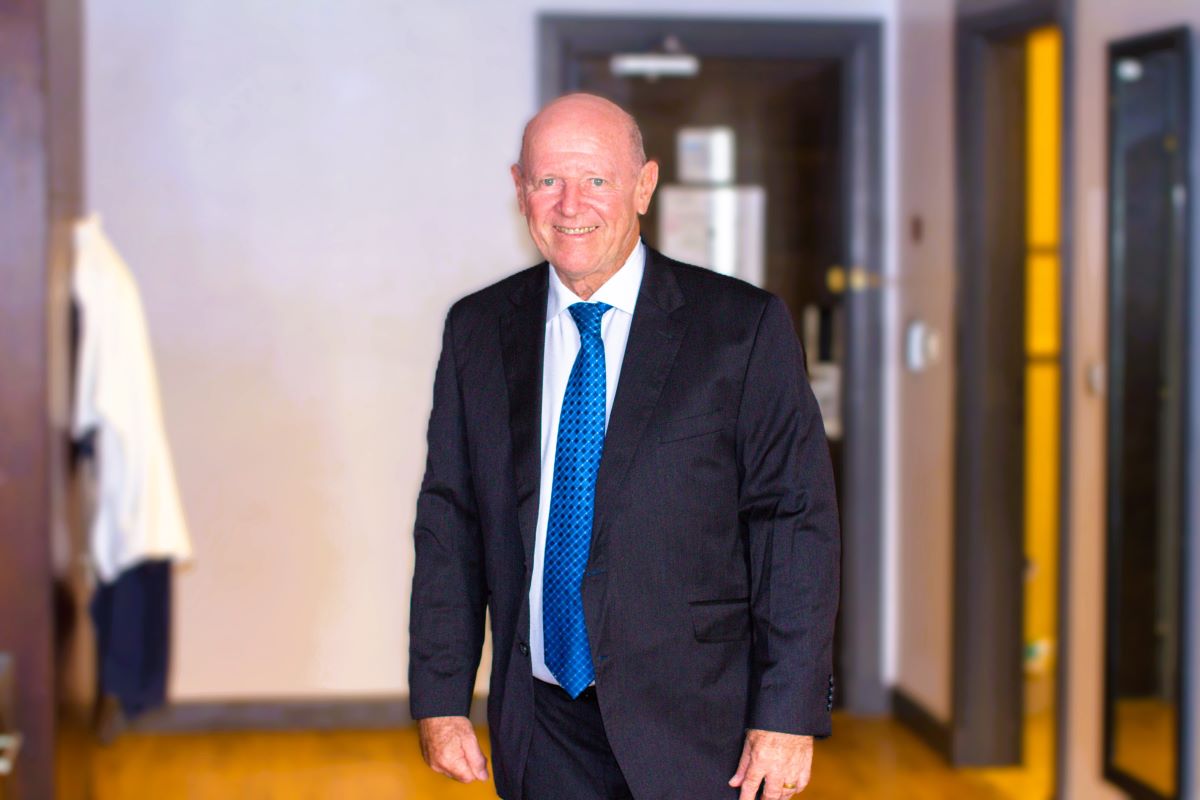
Celebrating Alain St. Ange, Seychelles’ Ambassador-at-Large on His Birthday
Alain St. Ange needs no introduction. A widely travelled and highly respected legend of the tourism industry, he was in Lagos, Nigeria, in January 2024 on a working visit, and to attend a surprise birthday party for Amb. Ikechi Uko, organiser of the AKWAABA African Travel Market. I caught up with him for breakfast, received an autographed copy of his biography, Alain St. Ange: A Life in Tourism, by Pascal Viroleau, and conducted this very interesting interview.
This interview originally published as Breakfast with St. Ange is republished today 24 October, on the occasion of the birthday of Alain St. Ange who was appointed Ambassador-at-Large for the Seychelles on March 25, 2026.
My name is Alain St. Ange. I served as Minister of Tourism, Civil Aviation, Ports and Marine of Seychelles. I believe my tenure was a period of consolidation for the tourism industry. Its greatest success, for me, was bringing the Seychellois people to understand that they are an integral part of the industry—one that remains the pillar of the Seychelles economy.
Too often, countries across the world—North, South, East and West—treat tourism as though it belongs only to the commercial side of the nation: to businesspeople, investors and entrepreneurs. This is wrong.
Tourism belongs to the country. It belongs to the people. When the commercial sector, entrepreneurs and the wider population work together—valuing all the assets of the country—tourism succeeds. Its success lies in this holistic approach: a population that sees itself as part of the industry, and therefore defends it as the pillar of its own economy.
History of Seychelles’ airport. Sir James Mancham. The first Carnival. The “Carnival of Carnivals.”
Seychelles is a very young country. We had an airport only in 1971, officially opened in 1972. When the airport was being constructed by the British, we were still a British colony.
The Chief Minister of that era, who later became our founding President, Sir James Mancham, asked: “How do we put a new country on the world map?”
At the time, the only access to Seychelles was through shipping lines running from India to Kenya. We had no planes and no other means of access. To bring this new country into the world of tourism—to suddenly say, “We will have an airport; come and visit us”—he needed one major event.
So he created the first Carnival of Seychelles. That carnival attracted considerable international press coverage.
He was a very dynamic person, with the willpower and ability to speak compellingly to the press. The press heard his message. That first carnival positioned Seychelles as a new tourism destination on the world stage.
A second edition of the carnival was held for Independence in 1976. The first carnival had been in 1972, but after that, we did not really stage it again for many years. We were comfortable in the position we had entered: tourism was working, and we were content.
When I was appointed to office, I said to myself that competition had become much tougher. Everyone was fishing for tourists from the same fishing bank. We needed something that would bring the press to Seychelles.
We were fully aware that inviting the press to see another beach, swim in our turquoise waters, however clear and clean, or sit on our white sandy beaches, would only work once or twice. They would not repeat the same story year after year; it would become boring and monotonous.
So I decided to bring culture into the tourism marketing of Seychelles. When you bring culture, you bring people. An event built around culture, with mass participation, was therefore interesting. And to ensure the press came, we coined the phrase: “The Carnival of Carnivals.”
We invited the best carnivals in the world to Seychelles. Brazil came. Notting Hill from England came. The Carnival of Venice from Italy came. The French Carnival of Cannes came. We also had the carnivals of Düsseldorf and Cologne in Germany, and Trinidad and Tobago.
To make it even more compelling, we invited cultural groups from countries around the world to walk side by side with the best carnivals.
At the last carnival, 36 countries participated. We discovered countries whose cultural depth I had not even fully appreciated—such as Sweden, whose mountain communities came and sang in the carnival. We had country-and-western groups from the Americas. We had participants from Russia, China and the Far East. They were all together.
My message was this: like South Africa, we are a rainbow people—but Seychelles lives as a rainbow nation. That is who we are. We come from a melting pot of cultures. There was no indigenous population in Seychelles before it was settled; we all came here to build a country.
We brought together people of different colours, ethnic groups, religions and sexual preferences, and everyone was treated with dignity as a person.
Even at the United Nations, whenever someone speaks at the General Assembly, some delegations walk out. When another speaks, another group walks out. But in Seychelles, every delegation was able to walk side by side and be respected for who they were.
That attracted press from every corner of the world. Journalists descended on Seychelles in such numbers that we could hardly contain them. Television stations, print media and online press all came.
First, they saw an extraordinary diversity of cultures gathered in one place. Secondly, they saw the world’s best carnivals walking together. Thirdly, they saw the respect Seychelles showed for people—as a country that described itself as a melting pot of cultures, living as a rainbow nation.
It was a resounding success. It is still spoken about today. It is still remembered. And it remains the biggest cultural event ever staged in Seychelles.
I am very proud that the team at the Ministry of Tourism and Culture during that period, under my guidance, staged that event from zero and made it a worldwide success.
Africa’s tourism potential, visa-free travel, intra-African connectivity, African Union leadership, and the need for Africa to rewrite its own narrative
Africa, as a continent, has everything it needs to succeed, because everything is here. You can talk about safari, big-game fishing, beach holidays—anything you can think of, Africa has it. Yet Africa receives only about 6.5 per cent of worldwide travellers. That is very low for a continent that has everything. Why is that?
Many of the challenges Africa faces are man-made. The second challenge is the willpower of governments to address them. I salute Rwanda, because they said it, and they made it happen.
I also salute Kenya for embarking on a project to make the country visa-free. Kenya and Rwanda are strong tourism destinations in their own right. They compete with each other, even though both are members of the East African Community. But they are looking at the bigger picture: bring more people to Africa, and every African country will benefit.
Seychelles adopted a visa-free approach at Independence in 1976. Our founding President made a statement that still resonates today: “Friends of all, and enemies of none.”
If you are my friend, you can visit me. You do not need a visa to visit me. You do not need permission to visit me. You come because you are my friend. If every nationality is declared a friend of Seychelles, then everybody can come.
Yes, there will be individuals—not the population of an entire country—who must be held accountable because they break the rules or the laws. For example, if someone attempts to import drugs into the country, we will find ways to prevent that entry. But that is not the whole population.
Punishing the entire populace of a country is the wrong approach. It goes against the principles and laws of today’s community of nations.
So how do we address this challenge of travel between states, travel within individual states, and access to different countries?
When I was still in office as Minister, I was invited to Gabon by its government to discuss tourism, to see the country’s natural attributes and key unique selling points, and to advise on how tourism could be developed there. I mention this because it was a classic example.
To travel from Seychelles to Gabon, I had to fly to Paris, change planes in Paris, and then travel on to Gabon—spending a night in Paris. It was a long journey to cross Africa, when the trip could have been far simpler. That is only one example; there are many such examples across Africa today.
How do we make ourselves more appealing to the world?
First, Africa needs Africans to know Africa. Too often, Africans do not know Africa. We speak of our love for Africa, our motherland, and we are very proud of it. But when people from Africa go on holiday, many choose destinations outside the continent rather than visiting another African country. We are often more interested in looking at what the other side of the world is doing.
If we are going to purchase something, we often buy from across the world instead of buying from Africa. These are challenges we must confront. We need to find a way for every African to be genuinely proud to be African. We say we are proud—but are we really?
Look at every flight arriving in Africa from Europe. It is full of people returning with boxes and large bags tied with Sellotape, because they have gone there to shop. We do not always recognise that many of the same things exist in our own countries and across our continent. This is a simple example.
But if we travelled more within Africa, we would increase travel demand across the continent. That, in turn, would encourage airlines to introduce more intra-African flights. Airlines do not operate flights simply for the sake of it; they operate where there is demand.
If we visited our own continent more, that demand would grow. As someone in tourism—a tourism consultant—I am proud that I travel across Africa extensively. I see and appreciate what Africa has to offer. Every day, there is something new to discover: the culture, the people, the unique selling points, the food and the cuisines of different countries.
In Ghana recently, I discovered a chicken dish that I continue to think and talk about, because it made a deep impression on me. It is a dish we do not prepare in Seychelles, but it is part of that country’s culinary heritage. It should be promoted today as a natural asset of Africa.
There are so many such assets. As a continent, we need to know ourselves, develop pride in Africa among Africans, and, at times, put the past behind us and move forward. We must move forward, because that is the only way we will achieve new heights.
People often say that Africa has every colour that makes an African. You can have a Chinese African, an Indian African, a white African or a Black African. But they are all Africans. When we respect that reality, we will be moving forward.
When the Americans landed on the moon, they said: “That’s one small step for man, one giant leap for mankind.” If Africa embraces all the cultures of the world, it will be a small step for us to echo—but a giant leap for Africa. Through this, we become the rainbow continent, living as the rainbow people of a continent.
That will help us move beyond the borders that were established to divide cultures and ethnic groups. It will make us stronger as a continent. But can each country achieve this alone? No.
We need regional bodies to take ownership and improve access within their regions. The regions must then come together and say: now, we will open up the continent. Often, countries are constrained by the political dilemmas they face. It is sometimes easier to bring in an external facilitator, mandated by three or four countries, to help drive these steps forward.
When that happens, Africa will be strong. Today, some countries face payment difficulties because of foreign-currency shortages. This happens partly because we trade outside the bloc instead of within it. Personally, I do not believe that BRICS membership or simply being part of the United Nations will change Africa.
Africa needs to ensure that the African Union becomes the heart that brings us all together. The African Union must listen to every sector of the economies of its 54 member states. It should be able to say: tourism is strong in Africa, so we have a tourism desk; mining is strong in Africa, so we have a mining desk.
We should not have desks only to address coups d’état or Ebola. Those are the least of our problems. Such challenges will be easier to resolve when the economies of our countries are strong. We must work to strengthen those economies by identifying every asset each country possesses and projecting those assets to the world.
Imagine going to a tourism trade fair and, instead of seeing separate national stands, entering an Africa House. As you enter, the roar of a lion welcomes you. You see the different faces of Africa serving as hostesses. We would present a new face of Africa: a face of unity, and of a continent ready to receive visitors.
In doing so, we would enhance the appeal for airlines to connect these countries. Tourists coming from the farthest markets no longer want to visit only one destination. They want to see one country, then hop across to the neighbour, and perhaps visit two or three states.
That is how we must respond to the post-COVID era and to the conflicts the world faces today—between Russia and Ukraine, and between Israel and Palestine. We need to think beyond the past and be ready to shape the future as a continent.
Current consulting work across Africa and ASEAN, guest speaking, the UNWTO candidacy, and his advocacy for an African tourism ministers’ body.
The last two or three years have been very rewarding on the tourism consulting circuit. I work with different states across Africa and Asia, primarily within the ASEAN bloc. There, I work closely with ministers of tourism.
Generally, I work with the minister personally—holding their hand, as it were—to help them view their ministry through an outside eye. We sit down, plan, and consider the best approach, much as I planned my own ministry when I was a minister.
There is a French saying that has been absorbed into English: “No one is a prophet in their own country.”
Having someone sit with you, examine the challenges you face, and advise on the approach to take can be invaluable. I also meet the trade with ministers, and the trade often appreciates an external perspective on a country’s internal issues—one that stands beyond politics and beyond the internal bickering that can exist within a country.
Last year, I made many trips in between my other commitments. While in Indonesia—actually in Bali for a conference—a biography of my life in tourism was launched. It was promoted by a person from Réunion Island who heads the Vanilla Islands group, together with an Indonesian writer who had put the book together.
It was a real honour to have a biography launched in my name. They interviewed me for hours and hours to uncover the intricate dilemmas of my work as a minister, as well as my earlier work in the private sector.
This week, I am launching a family history book, which traces the history of my family and that of my wife. It is called Alain & Ginette St. Ange: Family Ties.
We often become so embroiled in our daily work that we forget to reflect on who we are, on the family members we have, and on the respect we owe them: those who are here and alive, those who have happily departed, and those who helped create the life we have today.
Working across Africa and across the ASEAN bloc, you realise the need for togetherness. In Africa, I was fortunate to secure a consultancy advertised by the World Bank to support tourism development in Ghana.
It was a short consultancy, lasting eight months, but it reinforced for me how much work remains to be done across the continent. It is no use continually calling out to the world for help, aid, or support. We should engage professionals from our own continent to work with us. They understand us. They know Africa, its mentality, and its customs. Working in this way, Africa will succeed.
So I have done a great deal of work, and this year I am doing even more. I was surprised by how much travel was required in the first six months of the year, flying across Africa. Then, in June, there is a major conference on Africa in New York, where I have been invited to be one of four speakers. A great deal is happening.
I also do guest speaking. I am on several guest-speaker lists and am invited here and there to deliver addresses, which I enjoy greatly. The topics I am usually given relate to tourism, sustainable tourism, aviation, and how to remodel the tourism industry.
This brings me back to a point raised earlier: the United Nations World Tourism Organization, the UNWTO. I was one of the candidates who ran for the position of Secretary-General, representing Africa.
I described it as the highest office for a tourism minister—not the highest office for government civil servants or ambassadors, but the highest office for someone from the tourism sector. You need to understand tourism. You need to have lived tourism in order to lead tourism. Otherwise, it is impossible.
This is why I strongly advocate that Africa needs an African tourism ministers’ body—one that functions in a similar way to the UNWTO, but speaks specifically for Africa. First, there must be unity in Africa. Then, a body affiliated with the African Union should be established to move the tourism agenda forward.
Tourism is the only industry in the world that puts money directly into the pockets of its people. You may be a small businessperson or a large businessperson. You may rent bicycles, sell fruit and crops, or provide other services—all of that is tourism.
But how do we recognise it? How do we support it? How do we move this agenda forward with the heads of state and councils of ministers of the 54 African states?
If Africa establishes a tourism body for the continent—in the same way that we have SADC, COMESA and other regional bodies—it can help bring unity to Africa, identify the continent’s unique selling points, communicate them clearly to the world, and, through that body, finally allow Africa to rewrite its own narrative.
Today, when there is unrest in Africa, an outbreak such as Ebola, or a coup d’état here or there, it becomes global news. Positive news rarely makes the headlines because it is not considered sensational. But if Africa were rewriting its own narrative, it would tell the world about its positives while also addressing its challenges. That would point to a better future for the people of this great continent.
We need to do this—and the sooner the African Union adopts it as a resolution at one of its general assemblies, the sooner Africa will view its tourism industry with fresh eyes: eyes focused first and foremost on Africans, on every African. We must give them insight into tourism, equip them to work in the sector, support them as entrepreneurs at every scale, and enable them to become small business owners on their own continent.
Then we must define clearly what Africans can do, and what foreign entities can do.
There must be opportunities protected for us as Africans. You cannot open your country to the world, with all its financial power, only to find that Africans are edged out and gradually pushed aside—unable to make ends meet. That would be detrimental to the successful progress of the tourism industry.
Forthcoming autobiography, family history book, and the two planned books on politics and tourism.
By mid-year at the latest, I should have my own autobiography. It is something I have been considering for years—the idea of writing an autobiography that looks back on my life as a boy growing up on a small island with only 1,500 inhabitants at the time.
I grew up in a family of traditional farmers and plumbers. They grew vanilla and coconuts; they dried the coconuts, produced coconut oil, and worked the land. I grew up enjoying life on the farm with my school friends. Then, to attend school on the main island, I had to make the four-hour boat journey. We made that trip three times a year during the school holidays, returning to our island of La Digue.
My autobiography will take readers through all of this. It will also explore the hardships and tribulations our family experienced. We lived as a family—my grandfather, my father and myself—during the era when Seychelles was still a British colony. We witnessed Independence arrive. We lived through the military coup. We experienced the socialist period of government, and then the return to multi-party democracy.
All of that will be part of the story: my life in tourism in the private sector, my time as a government civil servant in tourism, and finally my years as a minister.
I believe my autobiography is rich because my life has been diverse. And I will end it with a simple statement: “I have had a full life, and I have no regrets.”
Nowhere in the book will you find “what if?”—no suggestions that I should have done this or could have done that. I have done what I wanted to do, and I have absolutely no regrets.
This autobiography will be followed by two final books in my own series. One will cover my life and time in politics; the other, my life and time in tourism.
The political book will look in detail at the political involvement of my family and myself in Seychelles. The tourism book will explore my own involvement in the sector, as well as that of my father, who was one of the pioneers of Seychelles tourism. He started a small hotel just as the airport opened in Seychelles.
He had foresight. He had vision. In many ways, he was instrumental in shaping the path I followed: entering politics, as he did, and dedicating my life to tourism, as he did.
He lived long, with a deep love for tourism. He believed that tourism was not merely an activity but an industry—one that required you to engage with it wholeheartedly. You had to be truly committed to the world of tourism, because tourism has become one of the world’s great employers. It is also an industry built on friendship, connections and partnership: a shared desire to remain connected and to work together.
This interview was conducted by ‘Niyi David at Four Points by Sheraton, Lagos and originally published as Breakfast with St. Ange.