
From Colonial Chronicles to Modern Memoirs: The Literary Archive That Defines Seychelles
A new comprehensive report traces the evolution of Seychelles’ published history, from early colonial medical accounts to the political memoirs of its founding presidents and the modern tourism narratives shaping the archipelago’s global image.
Books do more than fill shelves; they solidify a nation’s identity. For the Seychelles, an archipelago of 115 islands scattered in the Indian Ocean, the written word has been the primary vessel for preserving its unique blend of French, British, and Creole heritage. A newly compiled report highlights the vast and varied bibliography that has documented the islands’ journey from a British colony to a modern republic.
The Foundational Voices: Medicine, Archives, and Early History
The story of Seychelles literature begins in the colonial era with the meticulous work of Dr. John T. Bradley. A medical practitioner with a profound love for the islands, Bradley penned two definitive volumes in 1940: The History of Seychelles, Volume I (covering the French era) and Volume II (the British era). These works, now rare collector’s items, remain essential references in many Seychellois homes.
Following Bradley, Archivist A.W.T. Webb revolutionized history education in the islands. His tabular format and accessible writing style made his work a staple in local schools, ensuring that generations of students could easily grasp the complex timeline of their homeland. In 1952, F.D. Ommanney added to the canon with The Shoals of Capricorn, published by Longmans, Green and Co, further cementing the islands’ place in maritime literature.
Visualizing Paradise: Tourism and Art
As the islands opened to the world, a wave of pictorial books emerged to capture their natural splendor. Pioneering works by Richard Touboul, Claude Pavard, Marcel Fayon, Gabriel (Gaby) Hoareau and Amin, and Willetts and Skerrett became the definitive souvenir documents for visitors. To this day, these texts are celebrated for their ability to capture the diversity and beauty of the 115 islands.
Artistic interpretations also flourished. Leslie Thomas’s A World of Islands and Maryse Eichler’s Island Homes explored the architectural heritage of the islands, while artist Michael Adams brought the local spirit to life in Island Souls of the Seychelles and Conversations in Colour. Culinary traditions were preserved in local cooking guides, ensuring the islands’ rich gastronomic history was not lost to time.
The Political Chronicles: Voices of Power and Struggle
The political landscape of Seychelles is perhaps best understood through the memoirs of its leaders. The three founding presidents each left a distinct literary legacy:
- Sir James Mancham: The first president authored Paradise Raped, Seychelles Global Citizen, and reference works like Who’s Who in Seychelles and Images of Yesterday.
- France Albert René: The second president wrote The Torch of Freedom, Portrait of a Struggle, and The New Era. His biography, Albert René, The Father of Modern Seychelles, was later penned by Kevin Shillington.
- James A. Michel: The third president contributed Island Nation in a Global Sea and A Man of the People.
Dr. Maxime Ferrari, a key minister in the first two republics, offered a personal perspective in Sunshine and Shadows – Personal Story. These works, often reflecting the ideological currents of their respective eras, provide a critical window into the nation’s political evolution.
The 1981 Invasion: A Historical Turning Point
The failed mercenary invasion of November 25, 1981, remains a pivotal moment in Seychelles’ history, documented in four distinct accounts. The government’s official stance is recorded in the Livre Blanc de L’Agression du 25 Novembre 1981. In contrast, Mike Hoare’s The Seychelles Affair (1986) offers the mercenary commander’s perspective, while Aubrey Brooks’ Death Row in Paradise and Col. Jerry Puren’s Mercenary Commander (via Brian Pottinger) provide additional, often conflicting, narratives of the event.
Modern Narratives: Tourism, Law, and Legacy
In recent decades, the bibliography has expanded to include detailed tourism guides, legal texts, and personal memoirs. Julien Durup, a respected archivist, has chronicled the history of La Digue and the island’s first landowners. Francis E. MacGregor’s A Parliamentary History of Seychelles (2004) and Robert Smyth’s Mission FIC aux Iles Seychelles (2000) add depth to the nation’s institutional history.
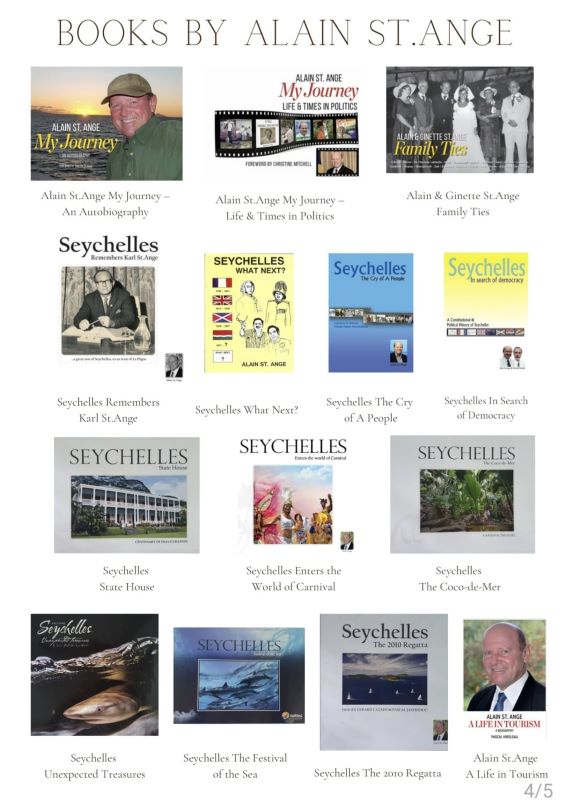
Alain St. Ange, a former Minister of Tourism and a prolific author, has shaped the modern narrative through works like Seychelles What Next?, Seychelles The Cry of A People, and his comprehensive autobiography Alain St. Ange – My Journey Life & Times in Politics. His collaboration with Glynn Burridge on titles like Seychelles The 2010 Regatta and Seychelles Unexpected Treasures highlights the intersection of culture and tourism.
In the legal sphere, Dr. Mathilda Twomey, former Chief Justice, co-authored A Practical Approach To Evidence For Judicial Officers (2023) with Dr. Joelle Barnes, Jocelyn Hackett, and Michelle Ebrahim, marking a significant step in the development of the nation’s common law applications.
A Living Library
From the “Unpublished Documents” compiled by A.A. Fauvel in 1909 to the 2023 biography Alain St. Ange, A Life in Tourism by Pascal Viroleau, the literary history of Seychelles is a testament to the islands’ resilience and evolution. As the report concludes, these books are not merely records of the past; they are the foundation upon which the future of the Seychelles is built, ensuring that the story of this “Forgotten Eden” continues to be told, read, and cherished.