Garamba National Park: Rhinos Return, Giraffe Recover in Quiet Recovery of Africa’s Oldest Wilderness
Once decimated by poachers and regional instability, Garamba National Park is staging a remarkable comeback—reintroducing white rhinos, monitoring recovering giraffe populations from the air, and laying the groundwork for sustainable eco-tourism.
Established in 1938 by Royal Decree of King Leopold III of Belgium, Garamba National Park is one of Africa’s oldest protected areas. But to understand Garamba today, you have to look past its colonial origins and into the remarkable recovery story that has unfolded over the last two decades—one where rhinos come home, giraffe numbers climb from the brink, and a landscape once stripped bare is fighting back.
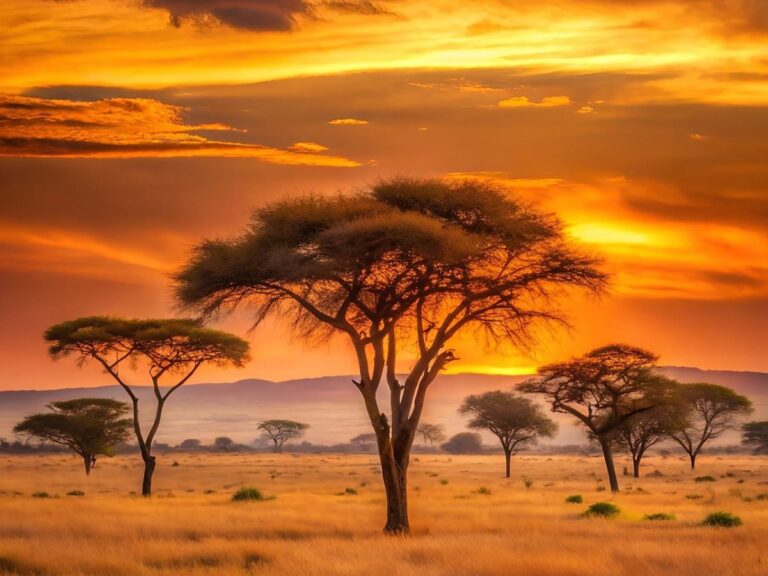
A Land of Savannah and Forest
Garamba spans 4,900 km² of Guinea savannah, woodlands, and gallery forests along the riverbanks, sitting in the transitional zone between the equatorial Congo Basin and the Sudanese savannah. An additional 9,662 km² of adjacent hunting domains form a larger protected complex that remains the last significant haven for elephants and giraffes in the Democratic Republic of Congo.
The park’s permanent water sources—unusual and vital in this landscape—support an extraordinary biomass of large herbivores. Hippos wallow in the Garamba River itself. Buffalos, bushbucks, waterbucks, Ugandan kobs, duikers, and the rare roan antelope roam the grasslands. Primates including Guereza colobus, Patas monkeys, vervet monkeys, and chimpanzees inhabit the forest patches. Predators—spotted hyenas, lions, leopards, and servals—move through the understory. Over 340 bird species have been recorded within its boundaries.
In 1980, UNESCO recognized Garamba as a World Heritage Site under criteria (vii) for its exceptional natural beauty and (x) for its biodiversity. Six years later, the same body placed it on the List of World Heritage Sites in Danger—a designation it has held, with one brief interruption, ever since.
The Long Shadow of Poaching
The danger listing was no exaggeration. From the 1980s through the 2010s, organized poaching networks—driven by ivory demand, armed conflict, and regional instability—decimated Garamba’s wildlife. By 2015, over 90% of the park’s elephant population had been lost. The northern white rhino population, once numbering around 15 individuals, was driven to local extirpation. Giraffe populations plummeted from an estimated 350 in the 1970s to just 22 by 2012.
It was during this darkest period that the world took notice. In 2005, the Congolese Institute for Nature Conservation (ICCN) entered into a co-management partnership with African Parks, a non-profit organization that has since transformed the park’s conservation trajectory.
The Turning Point
Since African Parks took the helm, Garamba has implemented some of the most aggressive anti-poaching measures on the continent. A specialized canine unit tracks poachers. Drones provide aerial surveillance. Patrols have been strengthened across the park’s vast terrain. The results speak for themselves: no poached giraffe carcasses have been found since 2017, and elephant poaching incidents have declined significantly.
The elephant population, devastated in the conflict years, has stabilized at approximately 1,200 individuals by 2025—one of the largest remaining populations of elephants within a protected area in the DRC, and unique as an intergrade between forest and savannah types.
The Kordofan giraffe—Garamba’s only giraffe population and one of the most dramatic recovery stories in African conservation—has grown from 22 individuals in 2012 to 70 in 2021, 92 in 2024, and an estimated 105 by April 2025. The subspecies, listed as Critically Endangered by the IUCN, has only around 2,400 individuals remaining across its entire range. Garamba now hosts two geographically distinct breeding groups, and in 2025, the park introduced a dedicated aerial monitoring protocol—one of the first of its kind globally—combined with AI-driven GiraffeSpotter software to identify individual animals.
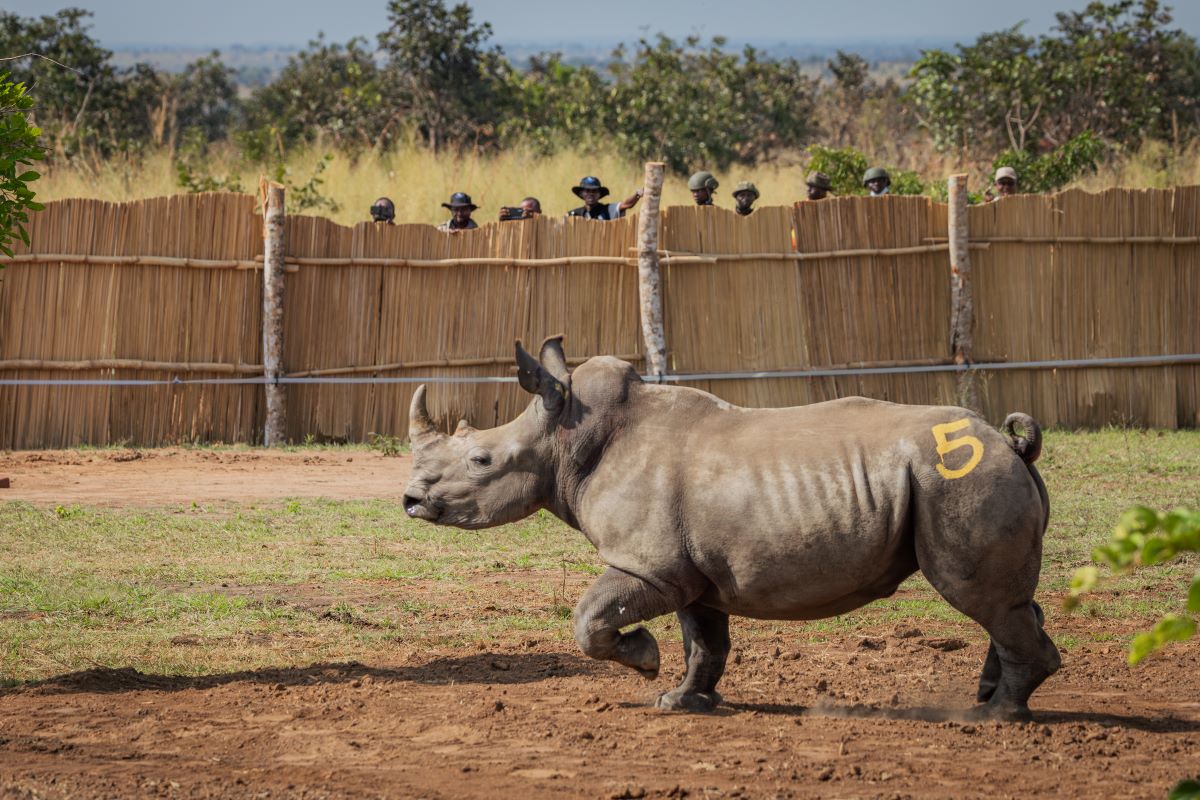
Perhaps the most symbolic victory came in December 2025 and January 2026, when southern white rhinos were translocated into Garamba after nearly two decades of absence. The reintroduction, backed by the European Union, marked the return of a species that had been locally extirpated and signaled a new chapter for the park. Today, roughly 30 white rhinos remain across Garamba’s boundaries.
The Work Ahead
The 2025 IUCN World Heritage Outlook rates Garamba’s conservation status as “Significant Concern”—acknowledging the progress made while flagging persistent challenges. Governance gaps, unresolved land tenure disputes affecting Indigenous communities, limited legal enforcement outside the park’s boundaries, and reliance on short-term funding all threaten long-term sustainability.
Buffer zones, critical for maintaining ecological connectivity with South Sudan, lack formal designation, leaving them vulnerable to human encroachment, illegal gold mining, and artisanal extraction. A 2021 financial audit estimated that Garamba requires $3 million annually—$12 million over five years—to sustain its conservation operations. The park is exploring carbon credit schemes and blended finance models, with a pilot buffer-zone project projected to generate $200,000 annually by 2025.
Eco-Tourism on the Horizon
The 2024–2028 Commercial Development Plan, approved by African Parks, outlines a strategy to grow sustainable tourism as a revenue engine for conservation. Garamba Lodge, renovated in 2023, offers basic amenities designed to blend with the natural environment and attract high-value visitors. Guides and lodge staff are undertaking exchange visits to build tourism capacity.
Yet significant barriers remain. The cost and difficulty of obtaining DRC tourist visas, ongoing regional insecurity, and underdeveloped infrastructure have kept visitor numbers low. Guided tours are currently restricted to limited, relatively safe zones, and visitor services still fall short of international standards in several areas.
For travelers willing to make the journey, Garamba offers something increasingly rare: a wilderness that feels untouched, a landscape where elephants and giraffe roam savannahs that have known nothing but silence for years, and now, slowly, the sounds of recovery.
The park’s story is not one of triumph declared, but of progress earned—inch by inch, patrol by patrol, calf by calf. It is a reminder that conservation in Africa is not about preserving what was, but fighting for what could still be.