Kenya Without the Binoculars: Discovering Lamu Island, Kakamega Forest & Marsabit
The country the world thinks it knows, and the three places that prove it has barely scratched the surface
Ask anyone who has never visited Kenya what they picture, and the answer is uniform: the savannah, the wildebeest, the acacia silhouette against a burnt-orange sky. They have seen it in documentaries and film credits, a signal that something wild is about to happen.
And Kenya is all of that. But it is also forty-seven counties, five climate zones, and a coastline trading with Arabia and India for a millennium. It is highlands growing the world’s finest tea, forests that feel ancient, and communities living lives entirely unrelated to the safari vehicle.
That Kenya—the one that gets on with the serious business of being extraordinary without waiting for an audience—is what this article is about. Here are three places, all Kenyan to the bone, none of them on the standard itinerary. All are worth rearranging your trip for.
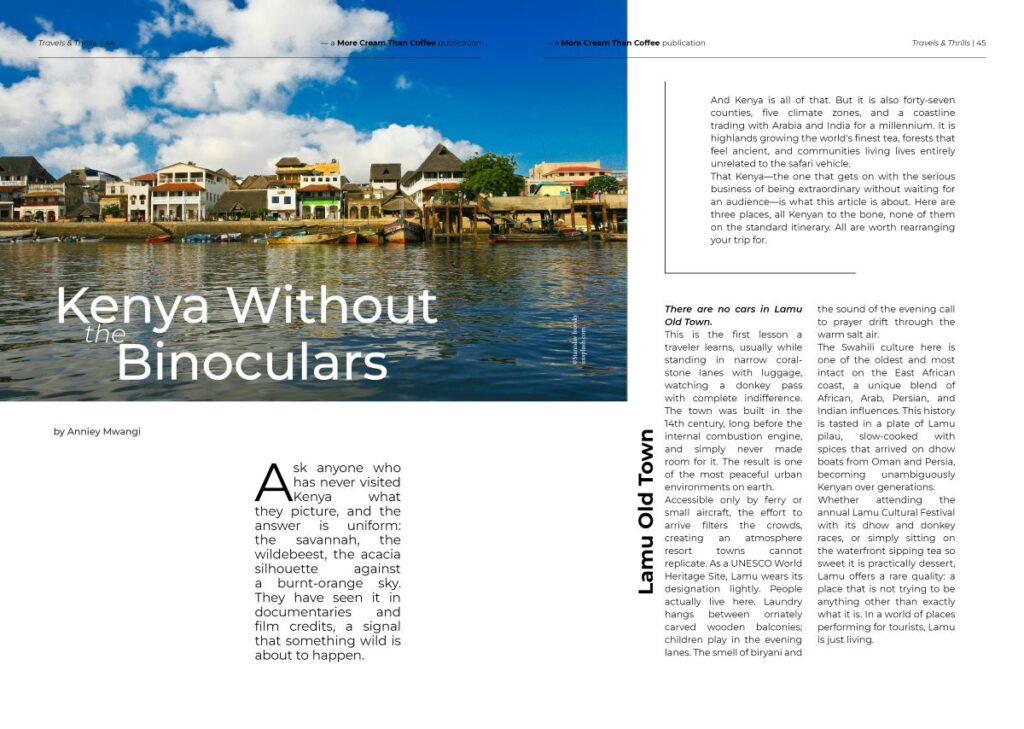
Lamu Old Town: The Island That Decided to Do Things Differently
There are no cars in Lamu Old Town.
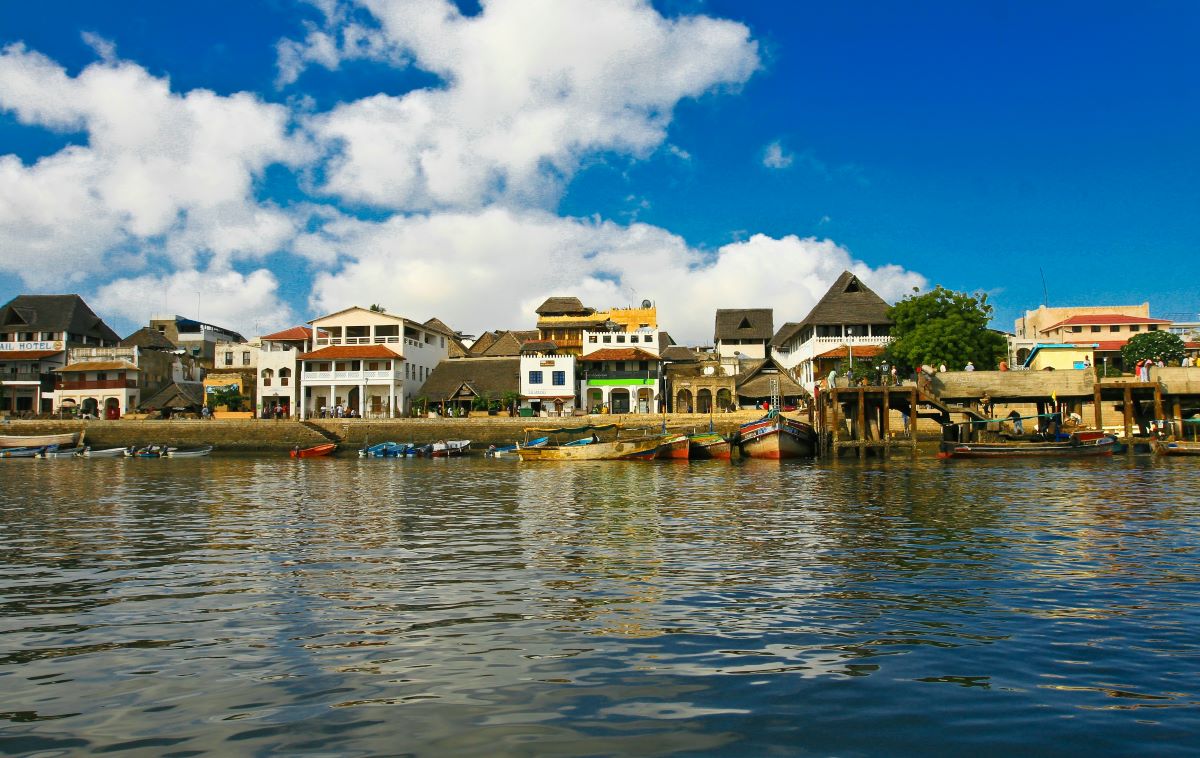
This is the first lesson a traveler learns, usually while standing in narrow coral-stone lanes with luggage, watching a donkey pass with complete indifference. The town was built in the 14th century, long before the internal combustion engine, and simply never made room for it. The result is one of the most peaceful urban environments on earth.
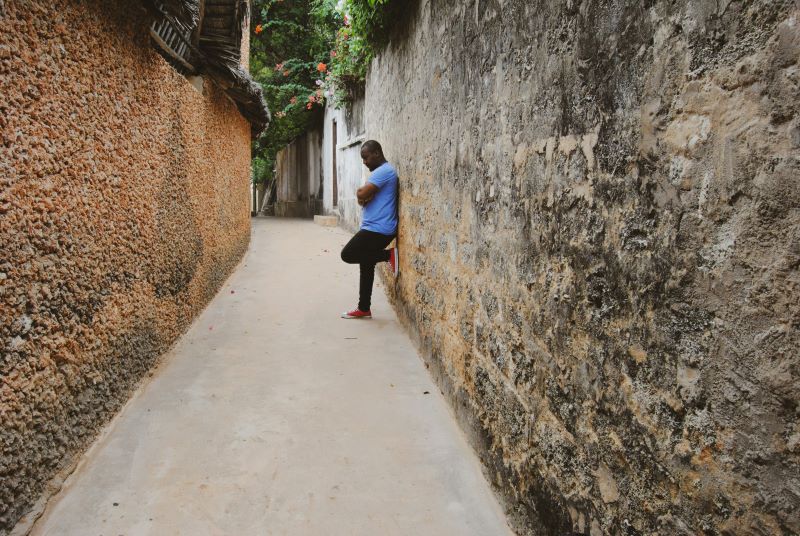
Accessible only by ferry or small aircraft, the effort to arrive filters the crowds, creating an atmosphere resort towns cannot replicate. As a UNESCO World Heritage Site, Lamu wears its designation lightly. People actually live here. Laundry hangs between ornately carved wooden balconies; children play in the evening lanes. The smell of biryani and the sound of the evening call to prayer drift through the warm salt air.
The Swahili culture here is one of the oldest and most intact on the East African coast, a unique blend of African, Arab, Persian, and Indian influences. This history is tasted in a plate of Lamu pilau, slow-cooked with spices that arrived on dhow boats from Oman and Persia, becoming unambiguously Kenyan over generations.
Whether attending the annual Lamu Cultural Festival with its dhow and donkey races, or simply sitting on the waterfront sipping tea so sweet it is practically dessert, Lamu offers a rare quality: a place that is not trying to be anything other than exactly what it is. In a world of places performing for tourists, Lamu is just living.
Kakamega Forest: The Last Fragment of the Equatorial Rainforest
There is a forest in western Kenya that does not behave like a Kenyan forest.
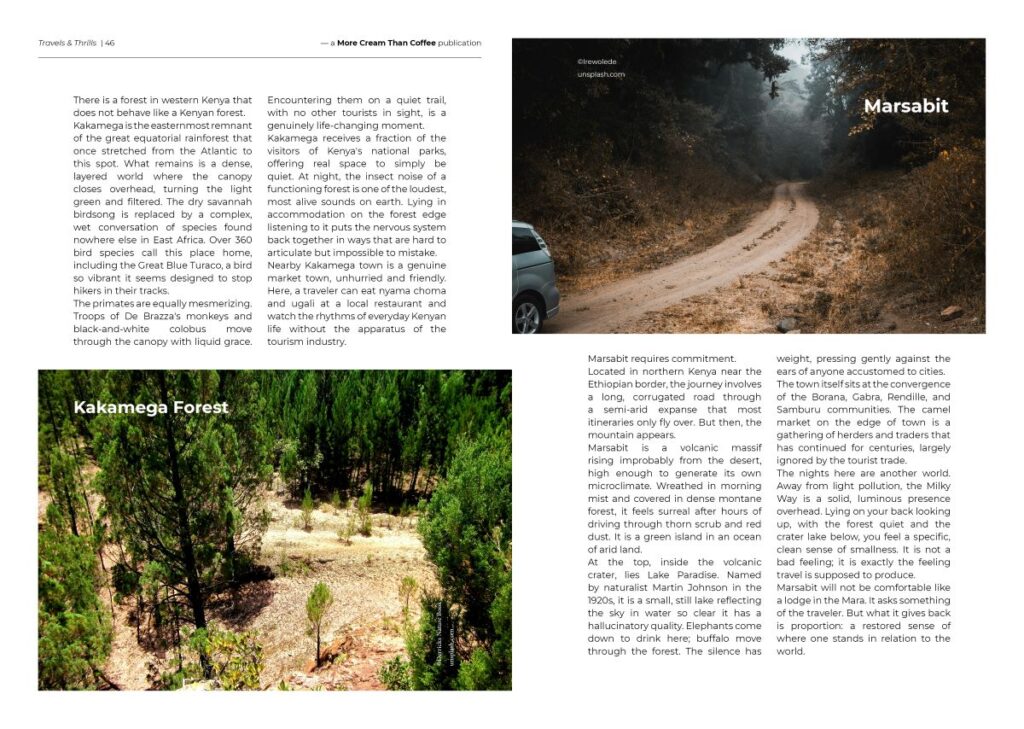
Kakamega is the easternmost remnant of the great equatorial rainforest that once stretched from the Atlantic to this spot. What remains is a dense, layered world where the canopy closes overhead, turning the light green and filtered. The dry savannah birdsong is replaced by a complex, wet conversation of species found nowhere else in East Africa. Over 360 bird species call this place home, including the Great Blue Turaco, a bird so vibrant it seems designed to stop hikers in their tracks.
The primates are equally mesmerizing. Troops of De Brazza’s monkeys and black-and-white colobus move through the canopy with liquid grace. Encountering them on a quiet trail, with no other tourists in sight, is a genuinely life-changing moment.
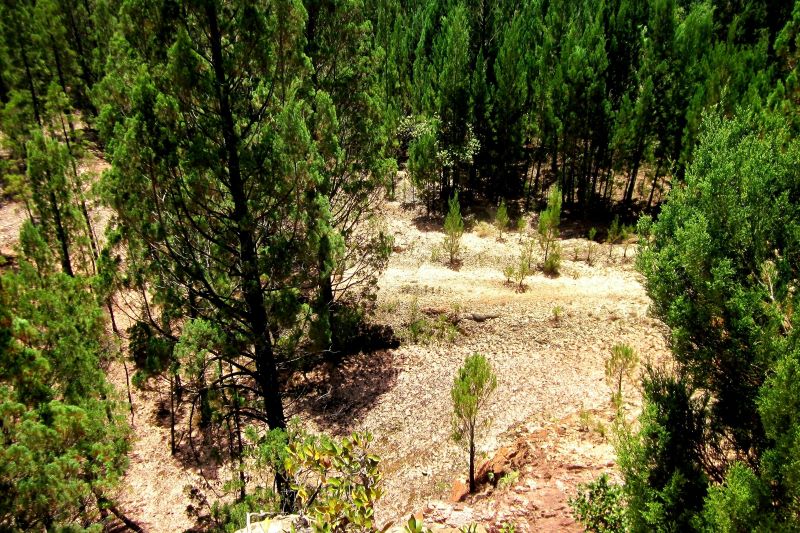
Kakamega receives a fraction of the visitors of Kenya’s national parks, offering real space to simply be quiet. At night, the insect noise of a functioning forest is one of the loudest, most alive sounds on earth. Lying in accommodation on the forest edge listening to it puts the nervous system back together in ways that are hard to articulate but impossible to mistake.
Nearby Kakamega town is a genuine market town, unhurried and friendly. Here, a traveler can eat nyama choma and ugali at a local restaurant and watch the rhythms of everyday Kenyan life without the apparatus of the tourism industry.
Marsabit: A Green Island in a Sea of Arid Land
Marsabit requires commitment.
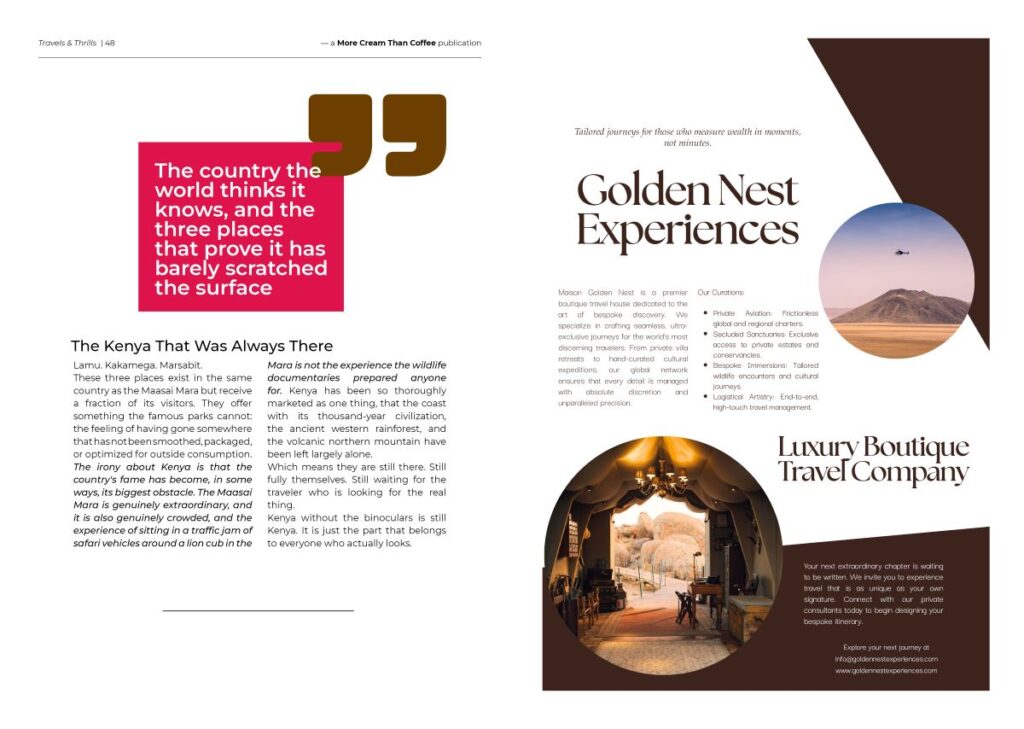
Located in northern Kenya near the Ethiopian border, the journey involves a long, corrugated road through a semi-arid expanse that most itineraries only fly over. But then, the mountain appears.
Marsabit is a volcanic massif rising improbably from the desert, high enough to generate its own microclimate. Wreathed in morning mist and covered in dense montane forest, it feels surreal after hours of driving through thorn scrub and red dust. It is a green island in an ocean of arid land.
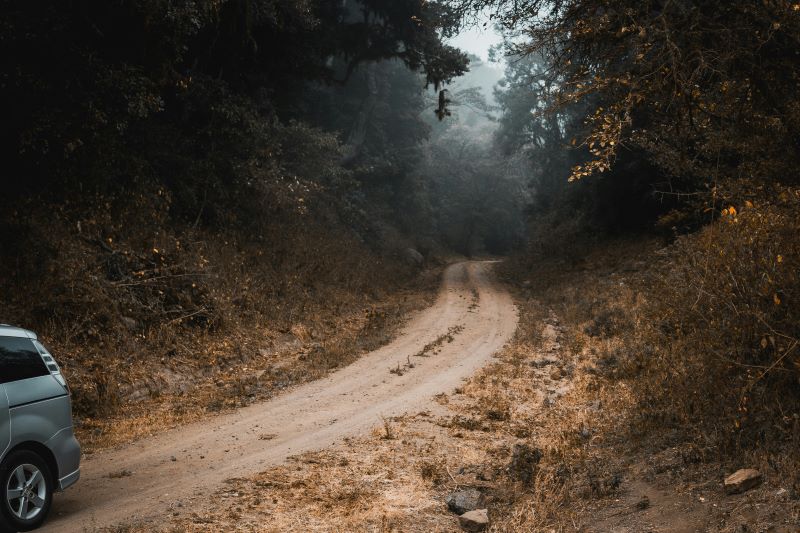
At the top, inside the volcanic crater, lies Lake Paradise. Named by naturalist Martin Johnson in the 1920s, it is a small, still lake reflecting the sky in water so clear it has a hallucinatory quality. Elephants come down to drink here; buffalo move through the forest. The silence has weight, pressing gently against the ears of anyone accustomed to cities.
The town itself sits at the convergence of the Borana, Gabra, Rendille, and Samburu communities. The camel market on the edge of town is a gathering of herders and traders that has continued for centuries, largely ignored by the tourist trade.
The nights here are another world. Away from light pollution, the Milky Way is a solid, luminous presence overhead. Lying on your back looking up, with the forest quiet and the crater lake below, you feel a specific, clean sense of smallness. It is not a bad feeling; it is exactly the feeling travel is supposed to produce.
Marsabit will not be comfortable like a lodge in the Mara. It asks something of the traveler. But what it gives back is proportion: a restored sense of where one stands in relation to the world.
The Real Kenya
Lamu. Kakamega. Marsabit.
These three places exist in the same country as the Maasai Mara but receive a fraction of its visitors. They offer something the famous parks cannot: the feeling of having gone somewhere that has not been smoothed, packaged, or optimized for outside consumption.
The irony about Kenya is that the country’s fame has become, in some ways, its biggest obstacle. The Maasai Mara is genuinely extraordinary, and it is also genuinely crowded, and the experience of sitting in a traffic jam of safari vehicles around a lion cub in the Mara is not the experience the wildlife documentaries prepared anyone for. Kenya has been so thoroughly marketed as one thing, that the coast with its thousand-year civilization, the ancient western rainforest, and the volcanic northern mountain have been left largely alone.
Which means they are still there. Still fully themselves. Still waiting for the traveler who is looking for the real thing.
Kenya without the binoculars is still Kenya. It is just the part that belongs to everyone who actually looks.
Kenya Without the Borders was first published in Travels & Thrills magazine Vol. 2, Issue 2 (May 2026).