Michael Balogun’s World Tourism Day Rebuttal: Foundation First, Technology Later
Founder/CEO of Tour2Nigeria, Otunba Michael Balogun points out what the global theme of WTD 2026 misses about Nigerian tourism, why AI cannot fix what concrete and capital can—and why the country’s 1,000+ attractions remain digitally invisible.
Around the world on 27 September, the tourism industry marked World Tourism Day under the theme “Digital Agenda and Artificial Intelligence to Redesign Tourism”—a subject chosen as UN Tourism spotlighted how AI tools now shape how travellers discover destinations, compare options, and book journeys. El Salvador hosted this year’s edition, framing itself as a case study in digital-first destination marketing.
In Nigeria, the conversation landed differently. In a shared post marking the day, Otunba Michael Balogun, Founder/CEO of Tour2Nigeria and Co-Founder of Naija Memorabilia, offered a correction that felt less like dissent and more like honesty.
“Artificial Intelligence (AI) will not build the road to our tourist destinations, nor will it replace the warmth of the Nigerian tour guide,” he wrote. “No matter the beauty of a destination, without proper road infrastructure, it remains inaccessible to a global audience.”
The Agbokim Test
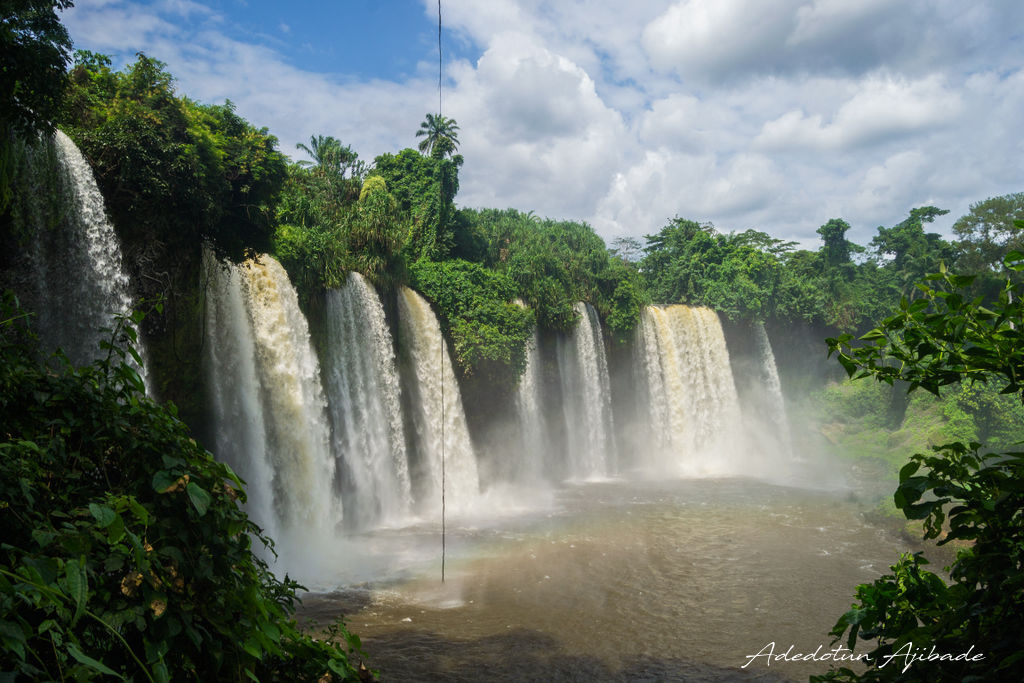
Balogun’s sharpest illustration was the Agbokim Waterfalls in Cross River State—one of the most visually arresting natural sites on the continent, a cascade tumbling through rainforest into a ravine. It is, by every measure, “beautiful.” And yet for most of the world, it does not “exist.”
That gap between existence and discoverability is where Nigeria’s tourism story actually lives. We are not short of wonders. We are short of roads, signage, safety protocols, power, connectivity, and accurate listings that would let a traveller in Berlin, Toronto, or Johannesburg find us, plan for us, and arrive safely.
Over 1,000 Attractions, Digitally Invisible
Balogun’s central statistic deserves to be pinned above every ministry desk: Nigeria holds over 1,000 tourism attractions, many of which remain digitally invisible. His framing of the theme is instructive—the point of a digital agenda should be moving destinations from hidden to discoverable. But that move requires prerequisites he names plainly: accessible, safe, and investment-ready.
Consider what “investment-ready” means in practice. A chatbot cannot negotiate land tenure with a community. A recommendation engine cannot guarantee that a visitor will not be accosted on the approach road to a site. An AI itinerary generator cannot promise potable water, functioning mobile signal, or an ambulance within reach. These are analog problems. They require concrete, budgets, training institutions, security presence, and political continuity—not prompts.
None of this is a rejection of technology, and Balogun does not frame it as one. His argument is about sequence: “the foundation must come before the technology.” That is the sentence worth arguing with, and worth agreeing with.
What the Digital Agenda Could Actually Do Here
Where we might push the argument further is this: foundations and digitisation need not be strictly sequential, because some digital work is cheap, fast, and within reach even while roads wait.
A national, verified database of attractions—coordinates, access routes, seasonal conditions, local operators, contact points—costs a fraction of a highway and would immediately end much of the invisibility Balogun describes. Community-run guesthouses could be listed. Local guides could be credentialed and findable. Oral histories attached to sites like Sukur, Gidan Makama, the Kano city walls, or the Ikom monoliths could be recorded before the elders who carry them are gone.
This is the version of the digital agenda that serves a country with crumbling arteries: not AI as a substitute for development, but digitisation as an act of documentation, dignity, and market preparation. You cannot attract investment into a product no one can see.
The Warmth Problem
There is a second concern buried in Balogun’s post that deserves emphasis, because it is the one the global theme genuinely overlooks. He notes that AI will not “replace the warmth of the Nigerian tour guide.” This is not sentimentality—it is the actual product.
Travellers do not come to Africa for architecture alone; they come for being received. The guide who knows which path is safe in the rains, who calls ahead to the village head, who explains why a festival happens when it does, who feeds you at his mother’s house because the timing ran long—that human infrastructure is irreplaceable, and it is currently underfunded, undertrained, and underpaid. If Nigeria redesigns anything, it should redesign the career path of the guide: certification, stipends, insurance, language support, digital literacy. Turn the warmth into a profession rather than a favour.
The Concern Is Not Technology. It Is Attention
The uncomfortable truth in Balogun’s message is that Nigeria’s tourism deficit is a symptom of a broader attention deficit. Sites decay because no office is accountable for them. Provinces vanish from travel maps because no budget line maintains them. Young people with fluent English, deep local knowledge, and entrepreneurial hunger leave the sector because it offers no viable livelihood.
Meanwhile, countries with a fraction of our raw inventory have built entire economies on coherence: a clear brand, consistent visa policy, maintained sites, trained guides, measurable targets. India, also marking this year’s theme, pointed to QR-based immigration clearance cutting processing to roughly 30 seconds per passenger and digitised customs easing entry for cruise groups. That is not magic. It is administrative competence applied to a bottleneck.
Our question on this World Tourism Day is therefore not whether AI will redesign Nigerian tourism. It will not—there is nothing to redesign until there is something functional to design upon. Our question is whether we will finally treat tourism as infrastructure and employment policy rather than decoration and conference material.
A Modest Ask
If the theme means anything here, let it mean three things before the next anniversary passes:
- Publish the map. One authoritative, open, verified register of Nigeria’s tourism assets, maintained as a living document.
- Fix the last mile. Prioritise access roads, wayfinding, and safety for a defined shortlist of flagship sites—not all 1,000 at once, but enough to prove the model.
- Professionalise the guide. Fund accreditation and continuous training, so that the warmth Nigerians pride themselves on becomes a paid, protected skill.
Do those, and AI becomes a genuine accelerant instead of an alibi. Skip them, and the digital agenda becomes the most sophisticated way ever invented to describe a country that remains unreachable.
As Otunba Balogun put it: for Nigeria’s tourism industry to truly benefit from AI, we must first make our destinations accessible, safe, and investment-ready. Happy World Tourism Day indeed—to a sector still waiting for its foundation.
Cover image: Agbokim Waterfalls by dotun55, CC BY-SA 2.0