A Plane, a Barge and a Beach: The Unforgettable 2012 Routes Africa Evening
The story behind Skippy’s impossible arrival of reaching a Seychelles beach by boat.
Some memories endure long after the conference banners have been packed away and delegates have flown home.
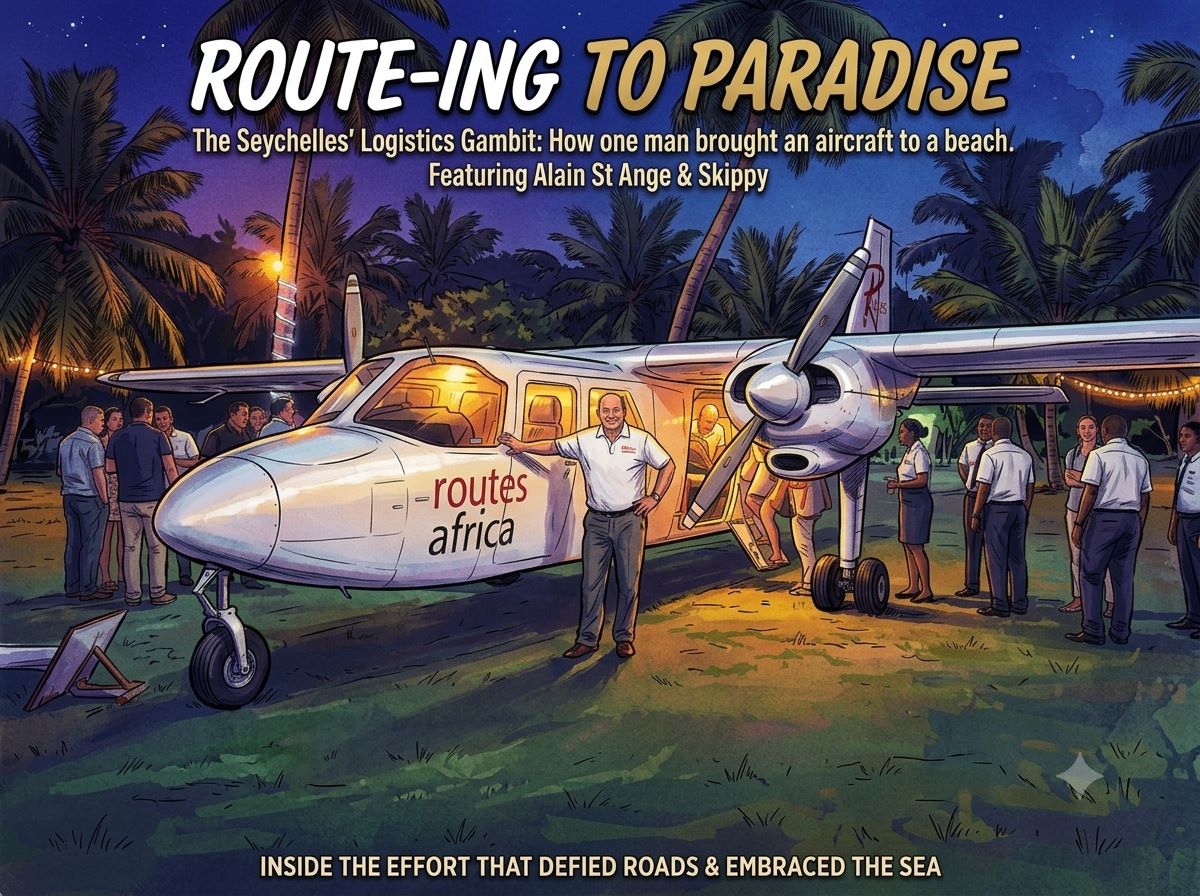
For those who stood on the beach at Cap Lazare in July 2012, one image remains especially vivid: a small retired aircraft resting on the sand, waves close by, its fuselage covered in handwritten signatures beneath the warm Seychelles evening sky.
Her name was Skippy. A Britten-Norman Islander, built in Bembridge on England’s Isle of Wight, Skippy had spent her working life serving the short-haul, island-hopping needs for which the aircraft was designed. By 2012, her flying days were over. Yet she found an extraordinary second life as the unlikely centrepiece of the Routes Africa Networking Evening during the seventh edition of the continent’s leading air transport forum.
Dressed in Routes and Routes Africa branding, Skippy drew delegates from across Africa, the Middle East and beyond. They queued for photographs beside her, left messages on her metal body and shared laughter as the sun set over the Indian Ocean. But few may have stopped to consider the logistical question that made the scene so remarkable:
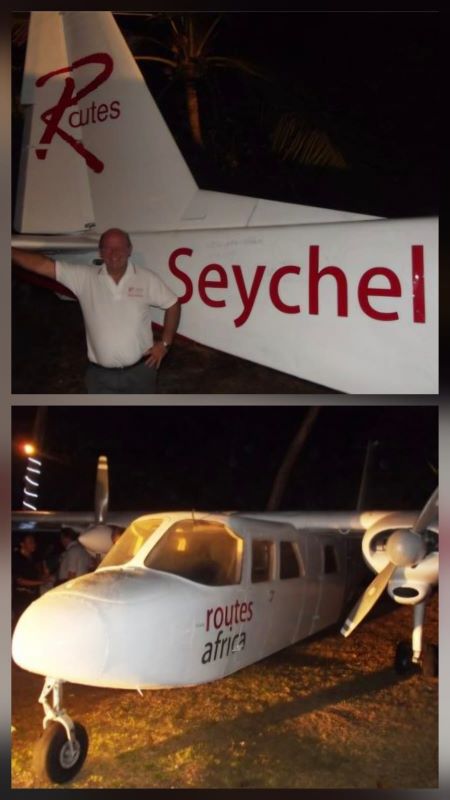
How did an aircraft get onto a Seychelles beach? The answer was simple in principle, though far from simple in execution. Skippy was too wide to travel along Mahé’s narrow roads. So the organisers did what islanders have always done when the land presents an obstacle: they turned to the sea.
The aircraft was moved from the airport onto a barge, transported across the water and carefully brought ashore at Cap Lazare, where road access could not accommodate her. The result was a memorable spectacle—and a fitting symbol of ingenuity, determination and connection.
A First for the Indian Ocean
Routes Africa 2012 took place from 8 to 10 July at the Kempinski Resort, Baie Lazare. It was the seventh edition of the event and, significantly, the first Routes Africa forum ever hosted in the Indian Ocean region.
The gathering had already travelled across the African continent—from Casablanca, Cairo and Dakar to Marrakech, Ezulwini Valley and Bamako. Seychelles marked a new chapter: an island destination hosting a forum devoted to connecting places, people and economies by air.
Nearly 300 delegates attended, representing airlines, airports, tourism boards, aviation bodies and industry partners from Africa, the Middle East and other markets. It became the most subscribed Routes Africa forum to date.
There was a quiet but powerful symbolism in that achievement. Every delegate had arrived by air, underlining the very issue at the heart of the conference: for islands such as Seychelles, aviation is not a convenience. It is a lifeline.
Seychelles cannot be reached by road or rail. Its links to the world depend entirely on sea and air. Tourism, trade, investment, family connections and access to international markets all depend on those routes being maintained, expanded and made resilient.
The timing also coincided with an important national milestone. Seychelles International Airport was marking 40 years since its first commercial landing—an event that had helped open the islands to tourism and wider international engagement.
Aviation as an Island Lifeline
At the conference reception, Alain St Ange, then the Minister responsible for Tourism, spoke of aviation routes as:
“The arteries that feed the body of our individual and the body of our collective tourism industries—the industry upon which our prosperity depends on today, and upon which our prosperity will continue to depend on for years to come.”
His message was clear: connectivity is central to the survival and success of island economies. Routes do not merely bring visitors; they sustain livelihoods, create opportunities and keep a country connected to the wider world.
Minister Joel Morgan, then responsible for Transport, also looked to the future. He spoke of airport development plans intended to help Seychelles accommodate up to two million passengers annually by 2019. At the time, he noted that Seychelles was receiving more flights, operated by more airlines, than ever before.
Rather than relying solely on direct services, Seychelles was also prepared to strengthen its links through the major hubs of Africa, the Middle East, Asia and Europe. This was a practical recognition of how modern aviation works: connectivity often depends not on a single nonstop route, but on a network of relationships and well-planned connections.
David Stroud of Routes Africa described the organisation’s mission as facilitating “the physical linking of the world.” That phrase captured the spirit of the event—and, in an unexpected way, the story of Skippy.
When the Sea Carried What the Road Could Not
Skippy’s journey to the beach was more than a clever event-logistics story. It became a metaphor for the kind of problem-solving that connectivity demands. The roads were too narrow. The aircraft could not be driven to the venue. So a different route was created.
The sea carried what the road could not. That same spirit lies behind every aviation agreement, airport expansion, new route launch and hub connection. It is the willingness to find another way when the obvious route is unavailable. It is the determination to overcome geography, distance and infrastructure constraints in order to bring people closer together.
The Seychelles Tourism Board team captured the moment with a line that became part of the evening’s folklore. When delegates asked how the plane had arrived at the Cap Lazare entertainment venue, the answer was:
“Where there’s a Minister Alain St Ange, there’s a way.”
They added that nothing was ever considered too difficult or impossible.
A Lasting Image of Connection
More than a decade later, the delegates have long departed and the aviation landscape has changed in countless ways. Yet the image of Skippy remains: a modest island aircraft on a Seychelles beach, signed by delegates who had gathered to discuss the future of air connectivity across Africa.
It was an image filled with contrasts. A British-built aircraft, retired from the sky, had reached its destination by barge. A small island nation had welcomed the continent’s largest aviation forum. Nearly 300 industry leaders had arrived by air to celebrate the systems that make arrival possible.
For Seychelles, the effort was never simply about placing an aircraft on a beach. It was about making a statement: connection matters, challenges can be overcome, and geography need not limit ambition.
If you want to understand what air connectivity truly means to an island nation, begin with Skippy—the plane that came by boat.
Because in Seychelles, where the road may end but the ocean and sky remain open, the effort to connect will always be worth making.