
HAN Calls for Coordinated Workforce Development as NTB Commits to Skills Sub-Committees
At the Namibia Tourism Board’s bi-annual Industry Stakeholder Engagement Workshop on 20 October 2026, the Hospitality Association of Namibia pressed for a national roll-out of the 2023 Tourism Training Roadmap — winning agreement for dedicated skills sub-committees, while a proposed VATEL hotel school campus and an ambitious airport growth plan signalled confidence in the sector’s future.
Namibia’s tourism industry took concrete steps this week toward solving its most persistent constraint: people. At the bi-annual Industry Stakeholder Engagement Workshop organised by the Namibia Tourism Board (NTB) which was held on 20 October 2026, the Hospitality Association of Namibia (HAN) led a push for structured skills development that secured a commitment from the NTB to establish special sub-committees dedicated to skills training — a move widely seen as the first institutional step toward a coordinated national approach to workforce development.
From Co-Creation to Implementation
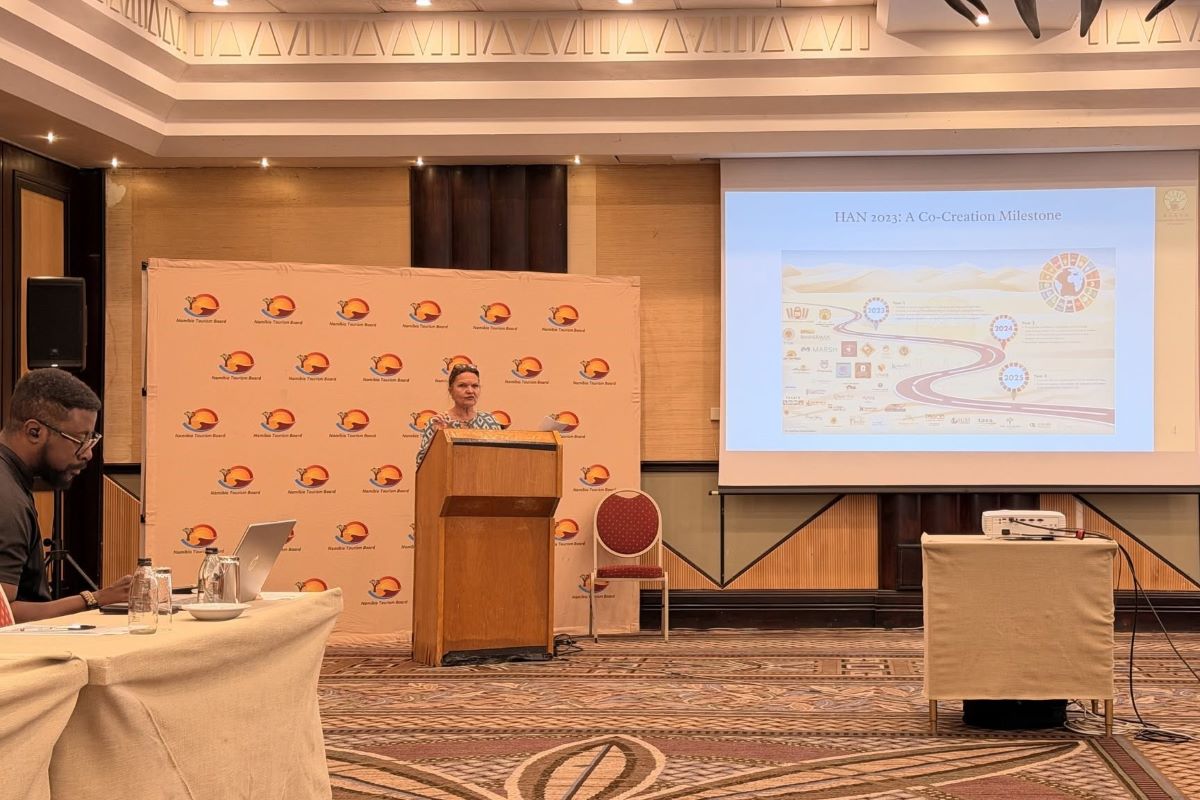
HAN’s presentation centred on skills development, drawing on the background of the Co-creation of the Tourism Training Roadmap of 2023 — the landmark process that brought together more than 24 training institutions and programmes alongside the travel industry to map a targeted network of development programmes against the sector’s skills deficit. The association encouraged the NTB to advance that work nationally, arguing that a roadmap without an implementation vehicle risks remaining a document rather than becoming a pipeline.
The NTB’s agreement to convene special sub-committees on skills training responds directly to that call, giving the 2023 roadmap a standing forum in which government, training providers and industry can align curricula, standards and funding.
The Wider Conversation: Sustainability, Safety and Making Careers Pay
Beyond training structures, discussions at the workshop highlighted sustainability, safety, professionalism, improved communication and data-sharing, and the need for training that reflects the realities of Namibia’s tourism industry rather than imported templates. The importance of vocational training was reaffirmed across stakeholder interventions — alongside a candid recognition that training alone will not retain talent unless tourism careers become genuinely attractive through better working conditions and fair remuneration.
That point echoes a warning HAN has made for years. “The biggest challenge facing the international travel industry today is a skills deficiency. Globally, the travel industry is experiencing an unprecedented shortage of skilled staff, and we here in Namibia are no exception,” HAN CEO Gitta Paetzold said when the training roadmap process was launched.
A Vatel Campus on the Horizon
The workshop’s most eye-catching announcement was the proposed establishment of a VATEL Hotel & Tourism Business School campus in Namibia from 2027, in collaboration with Roots Namibia. Windhoek and Walvis Bay are envisaged as possible locations. Vatel is the world’s leading business school group in hospitality and tourism management, with more than 55 schools across Europe, the Americas, Asia and Africa, and a model built on blending theory with professional experience. A Namibian campus would give aspiring hospitality managers international-standard training at home — potentially curbing the outflow of students abroad and raising the ceiling for local careers.
Airports Aim for 2.5 Million Arrivals by 2030
The Namibia Airports Company (NAC) also used the engagement to share its growth agenda: growing passenger arrivals to 2.5 million by 2030, improving airport operations, developing domestic routes, strengthening cargo services, and publishing monthly arrival statistics to support better tourism data. The targets sit within NAC’s Integrated Strategic Business Plan for 2026–2031, which prioritises infrastructure modernisation, including the planned new terminal at Hosea Kutako International Airport targeted for completion by 2030. Passenger growth projections indicate current infrastructure could become congested by 2029 or 2030, making expansion necessary to sustain operational efficiency.
The pledge of monthly arrival statistics is a quiet but significant win: reliable, timely data has long been a gap in Namibian tourism planning, and one that HAN has flagged in its advocacy for evidence-based decision-making.
A Shared Commitment
HAN welcomed the shared commitment to improve communication, data-sharing and joint decision-making, and said it looks forward to continued collaboration with the NTB and industry partners. With sub-committees now mandated, a global hospitality school tentatively pencilled for 2027, and airports gearing up for 2.5 million arrivals, the ambition is clear. The test now will be execution — turning October’s commitments into trained, fairly paid, and professionally proud Namibian tourism workers.