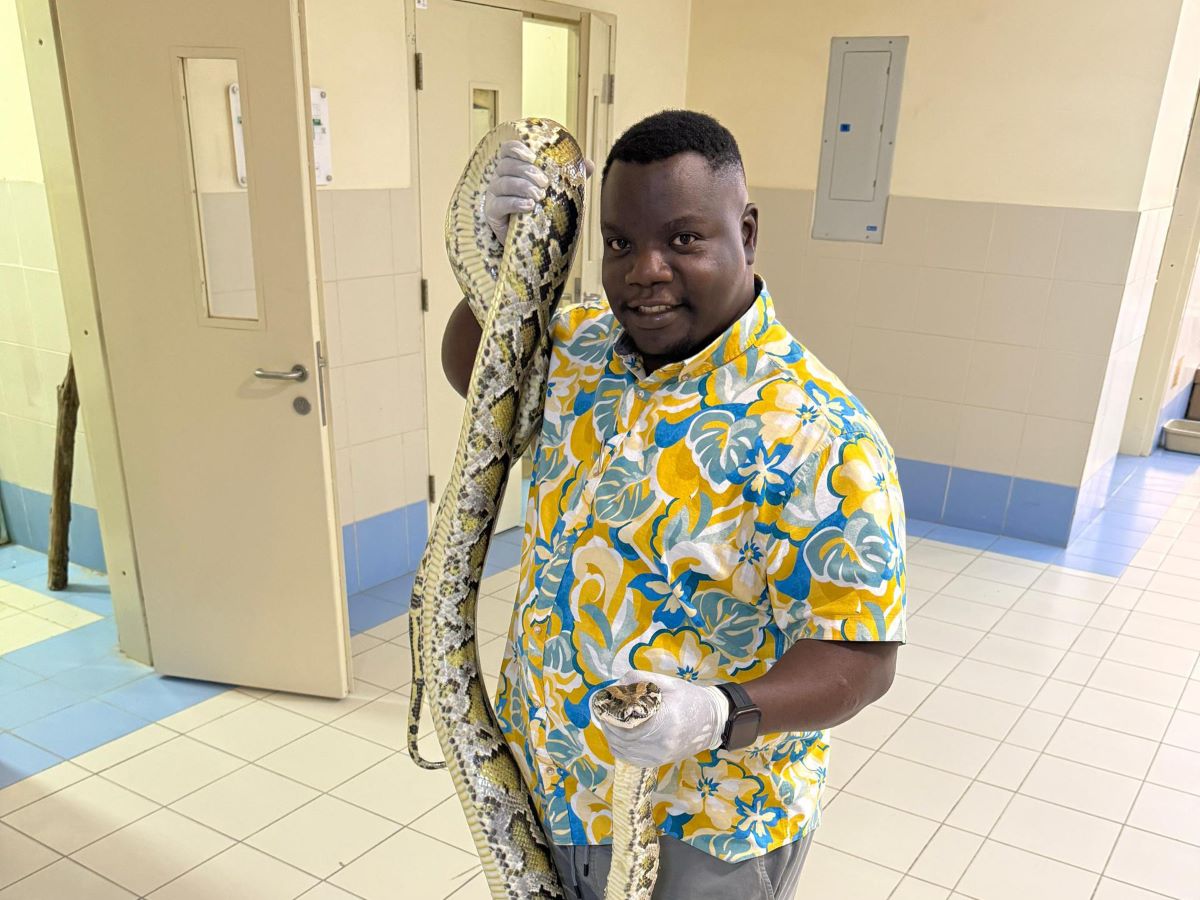
Emmanuel Mukasa: The Snake Whisperer of Uganda
When people think of Uganda’s wildlife, the spotlight usually falls on lions roaming Queen Elizabeth National Park or the majestic mountain gorillas of Bwindi. But tucked beneath the headlines is a quieter world — one of creatures that don’t roar or charge. Reptiles and amphibians: snakes, chameleons, frogs, and lizards. Though often feared and misunderstood, these animals are essential to Uganda’s ecosystems, and one conservationist is working tirelessly to ensure they are not forgotten.
Growing Up Among Scales and Slithers
Emmanuel Mukasa’s connection to reptiles began at home. In 1973, his father launched a legal wildlife trade that included amphibians and reptiles, meaning Mukasa quite literally grew up alongside snakes and frogs. “While other children ran from lizards, I watched them,” he recalls. His fascination with how they moved, hunted, and interacted set him apart early on. As his passion deepened, he pored over books, tracked reptiles through forests, and learned to handle them safely.
Locals began calling him “Misota” — Luganda for snakes — a name he wore with pride. “To me, it meant I was different. I saw beauty where others saw fear.” In 2015, with support from his friend Peter Twijukye, Mukasa founded the Herp Fauna Foundation with a goal that was simple but ambitious: to protect reptiles and amphibians, and to shift public perception. “These animals are not evil,” he says. “They’re just misunderstood.”
Battling Myths and Misconceptions
Uganda’s reptiles and amphibians face an uphill battle — not from natural predators, but from deep-seated cultural myths. In many communities, snakes are seen as cursed or dispatched by witches. Chameleons are rumoured to explode when they give birth, and some believe certain snakes carry magical gems. “These stories have been passed down for generations,” Mukasa explains, “and they’re hard to break.”

As a result, these animals are often killed on sight. Whether venomous or harmless, a snake found in a garden is likely to be burned or beaten. Even frogs and lizards — the harmless helpers of the food chain — are crushed or chased away. Meanwhile, natural habitats are vanishing. Forests are cleared for agriculture, wetlands drained for development, and wild animals are pushed into human spaces where fear meets them with violence.
The national conservation agenda largely overlooks these species too. “People talk about gorillas, elephants, lions,” Mukasa notes. “But rarely about reptiles.” Yet the danger is real: 32% of households surveyed by Makerere University reported a snakebite case in the family, with incidence recorded at 101 per 100,000 people. Only 4% of health facilities stock antivenoms, and a mere 8% of healthcare workers have received formal training in snakebite management — leaving communities dangerously exposed.
Herping with Heart
In Uganda, herping — the practice of studying reptiles and amphibians in the wild — is underfunded and largely overlooked. Equipment such as snake hooks, protective boots, and headlamps is difficult to source locally and often has to be imported from Kenya. Still, Mukasa and his team of 20 volunteers remain undeterred.
They visit schools, rescue animals from human settlements, and train communities to live safely alongside these creatures. Their work is fuelled by passion, not pay. Mukasa recounts a 2017 expedition to the Rwenzori Mountains where he was stranded after the River Mubuku flooded — yet that same journey brought him face-to-face with rare species like the Great Lakes bush viper and the three-horned chameleon. “Those moments stay with you,” he says. He also recalls spotting a Goldi’s cobra in Mabira Forest during his senior four holiday, and a close encounter with a rhino viper in 2007 in the now-vanished Kifu Reserve.
These experiences, though exhilarating, underscore a sobering truth: the habitats that make them possible are disappearing. Uganda is one of Africa’s most species-rich countries, yet it has lost vast stretches of natural habitat to agriculture — and its reptile and amphibian populations remain critically understudied, with taxonomic gaps that could affect conservation priorities at a global level.
Why These Animals Matter
Mukasa is quick to emphasise the ecological importance of reptiles and amphibians. “Snakes control rodent populations,” he says. “Without them, diseases like typhoid and plague would increase.” Frogs keep mosquito numbers in check. Chameleons feed on insects that destroy crops. Even snake venom holds medicinal value, used in developing treatments for conditions such as high blood pressure and cancer.
Education is therefore at the core of the Herp Fauna Foundation’s work. They teach communities that not all snakes are venomous, and that proper first aid — staying calm, keeping the affected limb still — can save lives. They also promote preventive measures: wearing boots at night and resisting the urge to kill or handle snakes. The stakes are high. Snakebite victims in Uganda frequently seek traditional healers before visiting a health facility, a delay that can prove fatal, particularly in rural areas where 97% of snakebite deaths across sub-Saharan Africa occur. “Education changes everything,” Mukasa says. “I’ve seen people go from being terrified to becoming protectors of these animals.”
A Vision for the Forgotten Species
Looking ahead, Mukasa dreams of building Uganda’s first reptile education and rescue centre — a space where children and adults alike can safely encounter these often-feared animals. He also hopes to spearhead research into locally producing anti-venom, a vital step towards saving lives in underserved communities.
Beyond that, he envisions a shift in national consciousness. “I want reptiles and amphibians to appear in school textbooks, tourism campaigns, and conservation plans — just like lions and gorillas.” The road is long, and he cannot walk it alone. He needs funding, equipment, research partnerships, and public support. “We don’t have to love them,” he says. “But we must learn to live with them. They are part of our ecosystem, just like lions and elephants. Without them, the system breaks.”
The Quiet Voices of Conservation
Mukasa’s story is a reminder that conservation is not only about the animals we admire — it is also about those we overlook, fear, or fail to understand. Sometimes, the smallest creatures carry the biggest messages.
Emmanuel Mukasa: The Snake Whisperer of Uganda was first published in Travels & Thrills magazine Vol. 2, Issue 2 (May 2026).