No Masks, No Lies: The Truth-Seeking Abissa Carnival of Côte d’Ivoire
Carnivals are often celebrated for their color, music, and liberation — but what if the true power of a carnival lay not in escape, but in confrontation? In the coastal town of Grand Bassam, Côte d’Ivoire, the Abissa Festival answers that question with a resounding “yes.” This is not a celebration of indulgence — it is a sacred ritual of truth, accountability, and renewal.
For the Nzema people, Abissa is more than a festival. It is a 14-day spiritual journey that begins with a single, profound question: “Do we deserve to enter the New Year?” The answer is not given by a priest or a chief — it is revealed by the Edogbole, the sacred drum, in a moment of intense anticipation and collective breath-holding.
The word Abissa means “the Question,” and the festival is a time when the community must answer it honestly. For two weeks, all non-essential activities — farming, weddings, funerals — are suspended. The entire community turns inward, reflecting on the past year and preparing to confess, forgive, and be forgiven.
The festival unfolds in two phases. The first seven days, known as Seidou, are a time of quiet preparation. Homes are cleaned, sacred items are gathered, and the Edogbole is moved from its hidden sanctuary to the public square. On the eighth day, the drum’s solemn rhythm echoes through the streets, summoning crowds to a ceremonial procession. Libations are poured, ancestors are invoked, and the festival officially begins.
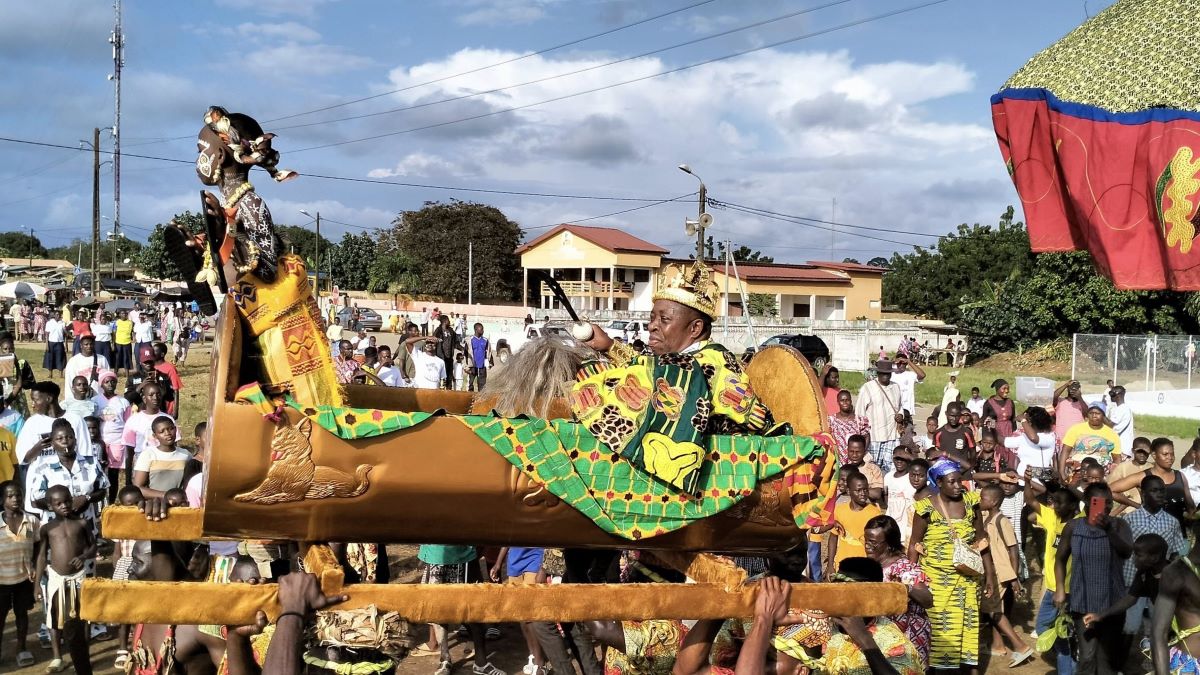
From that moment on, the rhythm of the drum becomes the heartbeat of the community. People dance through the night — elders, children, and travelers alike — as rituals unfold: the procession of the seven founding families, the dance of the Nkomyan (priestess), the appearance of the Ahenfie (royal court), and the public presence of the Nzema king, Kotoko. A unique tradition sees men dressed as women and women as men — a symbolic act of role reversal meant to challenge social norms and encourage self-reflection.
But the most powerful moment comes at dawn on the 14th day. The Edogbole is called upon to answer the central question: “Do the Nzema people deserve to enter the New Year?” If the drum answers affirmatively, the entire community erupts in celebration — not just of joy, but of collective redemption. The night is filled with music, barbecues, and beach parties — a release of the burdens carried throughout the year.
Why Abissa Matters
In a world where festivals often prioritize spectacle over substance, Abissa stands apart. It is not a performance — it is a living tradition that demands honesty, accountability, and transformation. It reflects the Nzema people’s deep respect for ancestral wisdom, their belief in communal responsibility, and their commitment to truth.
For travelers, Abissa offers a rare and profound experience — not of tourism, but of witnessing a culture that has preserved its spiritual core with integrity. It is a reminder that the most powerful celebrations are not those that let us escape, but those that bring us closer to who we truly are.
Plan Your Visit
The Abissa Festival takes place annually in Grand Bassam, a historic coastal town in Côte d’Ivoire. While the exact dates vary, the festival typically begins in late October. Travelers are encouraged to arrive early to experience the full 14-day cycle, from the solemn preparations to the final night of joy.
To fully engage with the festival, visitors should:
- Respect local customs and dress modestly.
- Participate with humility and openness.
- Support local artisans and food vendors.
- Be mindful of the spiritual significance of the event.
Abissa is not a show — it is a mirror. It asks us to confront our truths, to forgive, and to begin anew. In a world that often hides behind masks, Abissa dares to ask: Can you live without lies? And in doing so, it offers a rare and beautiful answer.